|
|
 |
|
One Health News |
| |
|
| |
| Found 1196 Matching Results. View archived News Here. |
|
|
|
| Prominent Maine United States Senator Meets with Infectious Diseases Society of America (IDSA) Representatives - Friday, June 10, 2011 |
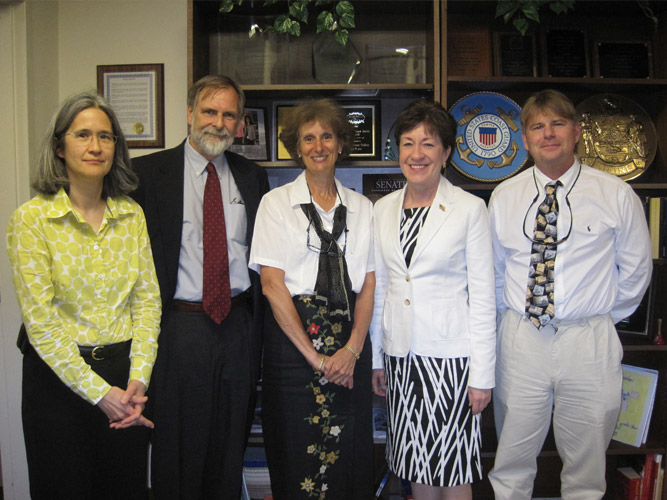
Left to right: Carol McCarthy, MD, Robert Smith, MD, MPH, Kathleen Gensheimer, MD, MPH, Senator Susan Collins (R ME), Rob Owens, PharmD
Prominent Maine United States Senator Meets with Infectious Diseases Society of America (IDSA) Representatives
Senator Susan Collins (R ME) visited with representatives of the Infectious Diseases Society of America (IDSA) http://www.idsociety.org/ on Wednesday June 1, 2011. Physician, Dr. Kathleen Gensheimer, a prominent One Health supporter/advocate briefly discussed with Senator Collins the One Health concept and handed her a copy of a recent letter (please see http://alturl.com/kv7y8) sent to Secretaries Kathleen Sebelius (U.S. Department of Health and Human Services) and Janet Napolitano (U.S. Department of Homeland Security) requesting assistance with crucial funding for a comprehensive “One Health” Institute of Medicine (IOM)/National Research Council Study/Report.
In addition Dr. Gensheimer gave the Senator a copy of the response (please see http://www.onehealthinitiative.com/publications/img053.pdf) from Alexander G. Garza, MD, MPH, the Department of Homeland Security’s Assistant Secretary for Health Affairs and Chief Medical Officer. Dr. Garza expressed the Department’s strong support for implementation of the One Health concept.
Senator Collins reportedly “was very involved and engaged, well informed on the issues and asked key pertinent questions about all subjects discussed.” Dr. Gensheimer said, “Drs. McCarthy, Smith, Owens and I primarily discussed antibiotic resistance and animal feeds with Senator Collins along with Methacillin Resistant Staphylococcus Aureus (MRSA), Clostridium difficile and hospital acquired infections. We also reviewed the critical need to sustain public health infrastructure, particularly in regards to laboratory and disease surveillance capacity. We specifically addressed the vectorborne disease challenges inMaine but also made a plug for continued resources on a global basis, especially for HIV, TB and Malaria. Senator Collins was very supportive of our efforts to inform and educate. We greatly appreciated her gracious reception and courtesy extended to us.”
|
|
| Recent Multidisciplinary “One Health” Paper Published by UK Physician and Team - Thursday, June 09, 2011 |
Recent Multidisciplinary “One Health” Paper Published by UK Physician and Team
“The intensification of livestock production and its impact on zoonotic disease risk”
The Communicable Diseases Policy Research Group from London School of Hygiene and Tropical Medicine, Faculty of Tropical Medicine headed by prominent research physician Professor Richard R. Coker, MD Richard.Coker@lshtm.ac.uk recently published an online “One Health” personal view article in the Lancet Journal http://centerforvaccineethicsandpolicy.wordpress.com/2011/04/03/framework-to-support-one-health-research-for-policy-on-emerging-zoonoses/ entitled “Towards a conceptual framework to support one-health research for policy on emerging zoonoses”.
Dr. Coker told the One Health Initiative website team, “In essence, if we're successful, this interdisciplinary research project will examine the interface between changing modes of livestock production and risk of zoonotic disease emergence. Our hypothesis is that rapidly changing systems for the production of animal-based foods will increase the risk of zoonotic disease outbreaks, including pandemics, and their social and economic impacts. Our aim is both to test this hypothesis and create a novel, interdisciplinary theoretical framework and methodological paradigm which can be used to further develop and explore this and other hypotheses about zoonotic disease risk.” He added, “This project is about zoonotic disease risk and its consequences. We will look at risk in the context of how zoonotic diseases are generated and distributed in livestock systems, how they may emerge from these into human populations, and how different zoonotic disease risk scenarios in human systems may affect public health and national economies.” |
|
| Maine Physician Public Health Consultant Strongly Endorses One Health - June 7, 2011 - Tuesday, June 07, 2011 |
Maine Physician Public Health Consultant Strongly Endorses One Health - June 7, 2011
“The “One Health” initiative, with its goal of improving animal and human health globally is long overdue. The increasing cadence of emerging infections and the complex inter-relationships that exist between humans, wildlife and the environment demands the simultaneous study of disease in humans and animals. Without collaboration amongst all health sciences, including human medicine, veterinary medicine, environmental health, wildlife health and public health specialists, we will be unable to meet new global disease challenges. Building on a common pool of knowledge will enhance integrated surveillance efforts which will translate in a reduction in time needed for the detection of novel or emerging disease threats. A multidisciplinary strategy will help prevent, control and where possible, eliminate infectious diseases within a larger ecological context that includes humans, animals and plants which interact in a complex, but ever changing natural environment.”
Kathleen F. Gensheimer, MD, MPH, FIDSA
Yarmouth, Maine (USA)
Note: Dr. Gensheimer is currently a public health consultant on infectious diseases in Cambridge, Massachusetts and is an active representative of the Infectious Diseases Society of America (IDSA). Prior to this, she was director of medical and scientific affairs at Sanofi Pasteur Biologics in Cambridge, 2009-2010. Dr. Gensheimer served as state epidemiologist for the Maine Center for Disease Control, Department of Health and Human Services from 1981- 2009.
|
|
| One Border One Health Symposium: San Diego, CA - June 23-24, 2011 - Monday, June 06, 2011 |
Important Notice: Don’t Miss ... One Border One Health Symposium (Details below)
June 23 - 24, 2011
San Diego, CA
One Border One Health Symposium
A Regional Symposium Advancing Cross-Disciplinary Collaboration and Border Surveillance for Emerging Infectious Diseases
Online Registration begins on May 11, 2011, and will continue through June 15, 2011.
See more: http://www.oneborderonehealth.com/
|
One Border One Health Symposium Agenda Day 1
|
|
Thursday, June 23rd 2011 / University of San Diego, Joan B. Kroc Institute for Peace & Justice
|
|
8:30 a.m. - 5:30 p.m.
|
|
|
8:30 a.m.
|
Registration
|
|
9:30 a.m.
|
Introductions: Suzanne Lindsay, PhD
Executive Director for the Institute for Public Health, SDSU
Assistant Professor, Division of Epidemiology and Biostatistics,
San Diego State University Graduate School of Public Health
|
|
|
Welcoming Remarks: Stanley Maloy, PhD
Dean, College of Sciences
Associate Director, Center for Microbial Sciences
Professor of Biology, San Diego State University
|
|
|
|
|
10:00 a.m.
|
Nathan Wolfe, DSc
Founder and Director, Global Viral Forecasting Initiative
Lorry I. Lokey Visiting Professor
Stanford University
|
|
11:00 a.m.
|
Q&A
|
|
11:15 a.m.
|
Lisa Conti, DVM, MPH, Dipl. ACVPM, CPM, CEHP
Director, Division of Environmental Health
Florida State Health Department
|
|
12:15 p.m.
|
Q&A
|
|
12:30 p.m.
|
LUNCH
|
|
1:30 p.m.
|
Panel 1: One Health Surveillance Strategies
Moderator: Patricia Conrad, DVM, PhD
Co-Director, One Health Center
UC Global Health Institute
Professor, School of Veterinary Medicine
University of California, Davis
Panelist: Scott Wright, PhD
Branch Chief, Disease Investigations
National Wildlife Health Center
U.S. Geological Survey (USGS)
Panelist: Jonna Mazet, DVM, MPVM, PhD
Director, Wildlife Health Center
Global Director, PREDICT Program
School of Veterinary Medicine
University of California, Davis
Panelist: James M. Wilson, V, MD
Executive Director
Haiti Epidemic Advisory System (HEAS)
Praecipio International
|
|
3:00 p.m.
|
Panel Discussion and Q&A
|
|
3:15 p.m.
|
BREAK
|
|
3:30 p.m.
|
Panel 2: Operationalizing One Health
Moderator: Francisco Javier Monge Navarro, DVM, MPH, PhD
Main Investigator B
Animal Health Department
Institute for Research in Veterinary Science
Universidad Autónoma de Baja California
Panelist: TBD
Panelist: Kristine M. Smith, DVM, Dipl. ACZM
Associate Director for Health and Policy
Ecohealth Alliance
Panelist: Nikos Gurfield, DVM, DACVP
San Diego County Veterinarian
Department of Environmental Health
Vector-borne Disease and Diagnostic Laboratory
|
|
5:00 p.m.
|
Panel Discussion and Q&A
|
|
5:15 p.m.
|
Closing Remarks
|
|
5:45 p.m.
|
Reception & Networking
Location: Best Western Hacienda Hotel
|
|
|
|
Action Planning Meeting Agenda Day 2
|
|
Friday, June 24th, 2011, Best Western Hacienda Hotel
|
|
8:30 a.m.
|
Breakfast & Registration
|
|
9:00 a.m.
|
Snapshot of the Border Region
|
|
10:15 a.m.
|
Action Planning - Group Discussion
Facilitator: Luke Entrup, MSW, MPH
Senior Evaluation Specialist
Institute for Public Health
San Diego State University
|
|
12:00 p.m.
|
Working Lunch
|
|
|
| Prominent Netherlands Physician Appointed First One Health Professor for Utrecht Life Sciences Faculty of Medicine and Veterinary Medicine - Sunday, June 05, 2011 |
Prominent Netherlands Physician Appointed First One Health Professor for Utrecht Life Sciences Faculty of Medicine and Veterinary Medicine
PRESS RELEASE
Roel Coutinho the first Professor for Utrecht Life Sciences
“Zoonoses form the new threat to public health”
Roel Coutinho has been appointed Professor for Utrecht Life Sciences at the Faculty of Medicine and Veterinary Medicine, with effect from 1 May. He intends to focus on the epidemiology and prevention of infectious diseases being at the interface between humans and animals. With the double appointment of Coutinho, Utrecht life Sciences is providing a significant stimulus to the ULS theme of ‘Public Health – One Health’.
The Executive Board of the University of Utrecht has appointed Dr Roel Coutinho as ULS Profiling Professor of ‘Epidemiology and the prevention of infectious diseases in the veterinary-human domain’, with effect from 1 May 2011. Professor Coutinho will collaborate with the Julius Center at the UMC Utrecht to explore new lines of research in the field of epidemiology and the dynamics of infectious diseases. In particular, he is planning to focus on the epidemiology of infectious diseases at the interface between humans and animals, the so-called zoonoses.
Humans and animals
In the wake of the Second World War, morbidity and mortality from infectious diseases started to decline more markedly in industrialised nations, due to the availability of effective vaccines and anti-microbial agents. “The result was great optimism. Many people assumed that infectious diseases had been suppressed”, comments Coutinho. “In the 1980s, HIV and AIDS forced a reversal in how people viewed infectious diseases. We realised that new infectious diseases are always appearing. Many of the new infectious diseases, and others appearing hither and thither, seemed to originate in the animal kingdom, from wild animals and also from domesticated livestock.” The latter source was more prominent in the Netherlands, with Bird Flu and Q fever, for instance. Professor Coutinho is concerned: “Zoonoses form the new threat to public health.”
Education
In addition to his research, Professor Coutinho will also be involved in teaching medical and veterinary students in the final stages of their training. He says “Collaboration between veterinarians and doctors is generally regarded as being essential in order to improve our chances of combating any zoonoses that might appear. This is why it is so important to maintain a focus of our concentration on this notion of ‘One Health’ during the students’ education.”
Coutinho
Professor Coutinho is a physician and a microbiologist, and Director of the Centre for Infectious Disease Control (CIb) at the National Institute for Public Health and the Environment (RIVM). He was previously the director of the GGD (Municipal Health Service) Amsterdam and a professor at the Academic Medical Center of the University of Amsterdam. He will combine his professorial duties at ULS with his present responsibilities at the RIVM.
------------------------------------------------------------------------------
Note to editorial staff:
For more information, please contact Saskia Ebeling via +31 30 253 8756 or
s.ebeling@utrechtlifesciences.nl.
Utrecht Life Sciences
Utrecht Life Sciences is a strategic partnership of academic, public and commercial players in the fields of education, research and innovation in life sciences. ULS acts as a driving force by generating collaboration among partners to promote healthcare for humans and animals. The ULS target programmes are ‘Public Health – One Health’ and ‘Cancer, Regenerative Medicine & Stem Cells’.
Utrecht Life Sciences is an initiative by the University of Utrecht, the Utrecht University Medical Center, the Utrecht University of Applied Sciences and Danone. The other partners are the Hubrecht Institute for Developmental Biology and Stem Cell Research (of the Royal Netherlands Academy of Arts and Sciences), Genmab, GlaxoSmithKline, Immuno Valley, TNO and Utrecht Holdings. ULS is supported by the Province of Utrecht, the Municipality of Utrecht and the Utrecht Region Innovation Taskforce. The strategic partners in education, research and entrepreneurship are all based at the Utrecht Science Park.
www.utrechtlifesciences.nl |
|
| Visionary Canadian Medical and Veterinary Medical College Deans Jointly Discuss One Health - Thursday, June 02, 2011 |
Visionary Canadian Medical and Veterinary Medical College Deans Jointly Discuss One Health
A visionary joint meeting of Deans from the Canadian medical and veterinary medical colleges was held in conjunction with the Canadian Conference on Medical Education in Toronto, Canada, in May 2011. The theme of the meeting, jointly organized by Elizabeth Stone (Dean, Ontario Veterinary College, University of Guelph) and William Albritton (Dean, College of Medicine, University of Saskatchewan), was “People and Animals Sharing Disease: Medicine and Veterinary Medicine Perspectives”. In addition to medical and veterinary medical Deans, meeting participants included representatives from the Public Health Agency of Canada, the Canadian Food Inspection Agency, and the Ontario Agency for Health Protection and Promotion. The event featured presentations on One Health and zoonotic disease prioritization by David Fisman (Dalla Lana School of Public Health, University of Toronto) and Jan Sargeant (Centre for Public Health and Zoonoses, University of Guelph), integration of veterinary medicine and human health in the community (Kate Hodgson, University of Toronto), and Rabies as a model for best practices for zoonotic disease prevention (Cathleen Hanlon, Kansas State University).
The meeting provided a forum for active discussion of zoonotic disease initiatives from both human health and animal health perspectives. Topics discussed included the potential for novel initiatives in joint undergraduate and postgraduate medical and veterinary teaching; the possibility of developing or identifying collaborative funding streams for joint medical and veterinary research in a climate of fiscal restraint, and the degree to which One Health efforts should be embedded in a broader emerging focus on “ecohealth”, which considers the health of humans and animals in the context of broader environmental health. A concept that generated considerable discussion was that of “zooeyia”, or health benefits of animal ownership, and it was argued that medical-veterinary education should stress this in addition to a more traditional focus on zoonotic disease risk. It is anticipated that this will become an annual event, resulting in stronger networks between the medical and veterinary medical colleges.
Information provided by:
David, Fisman, MD, MPH
Dalla Lana School of Public Health
University of Toronto and Department of Medicine
North York General Hospital (Canada)
and
Jan M. Sargeant, DVM, MSc, PhD
Director, Centre for Public Health and Zoonoses (CPHAZ) and
Professor, Department of Population Medicine
Ontario Veterinary College, University of Guelph
Guelph, Ontario, Canada
Dr. Fisman is a member of the One Health Initiative Team’s Honorary Advisory Board http://www.onehealthinitiative.com/advBoard.php and on the editorial Board of the Florida (USA) State Health Department’s One Health Newsletter http://www.onehealthinitiative.com/newsletter.php.
Drs. William Albritton and Fisman are physicians. Drs. Elizabeth Stone, Jan Sargeant, Kate Hodgson, and Cathleen Hanlon are veterinarians. |
|
| Prominent Swedish Physician Advocates One Health Principles to Fight Global Infectious Disease - Tuesday, May 31, 2011 |
Prominent Swedish Physician Advocates One Health Principles to Fight Global Infectious Disease
“With humans seemingly fighting a losing battle against the invasion of an ever-changing army of infectious diseases, how do we predict and prepare for the next epidemic? Björn Olsen, MD, PhD, Professor and Senior Physician of Infectious Diseases at Uppsala University, argues that only a continual collaborative effort between medical and ecological disciplines, to understand the relationship between infectious disease and biodiversity, can hope to stem the tide. ... “
To read complete article: Please see link http://alturl.com/wtpnj or PDF attachment posted on One Health Initiative website’s Publications page http://www.onehealthinitiative.com/publications.php.
Dr. Olsen is a member of the One Health Initiative team’s Honorary Advisory Board http://www.onehealthinitiative.com/advBoard.php.
Article produced by Projects Magazine - www.projectsmagazine.eu.com |
|
| General Invitation to "One Health" open forum discussion – RE: International Society of One Health Proposal - Friday, May 27, 2011 |
General Invitation to "One Health" open forum discussion – RE: International Society of One Health Proposal
During the first International Congress on One Health held in Melbourne in February 2011, it was agreed to hold a one day meeting to discuss the best way forward for the One Health initiative. The possibility was discussed of the formation of an International Society of One Health as one way forward but it was recognized that other options might be preferable. There was strong support for a second International One Health Congress.
We would like to extend an open invitation to any interested person or party to attend a meeting in London, U.K. in late June. The agenda for is meeting is given below:
Agenda
1. Introduction and background to meeting
2. Do we need a new international "body" to further progress "One Health" such as an International Society for One Health.
- why is something needed?
- what would be its functions?
- given the above how should it be structured, managed and be located?
3. Do we need a One Health dedicated journal? If yes
- how should it be produced (hard copy, e journal, web-based)
- how should be organized and financed
4. Do we want a second International One Health Congress. If yes
- who will organize this,
- where and when
- what format and areas should be covered
5. Summary and next steps
If you are interested please contact Anne Partridge at Anne.Partridge@CSIRO.AU as an expression of interest. Based on the response we will get back to you with further details,
The Organizing Committee,
Professor Martyn Jeggo
Professor John Mackenzie
Dr. David Heymann
Dr. Jimmy Smith
Professor Martyn Jeggo
Director
Australian Animal Health Laboratory
CSIRO Livestock Industries
PMB 24
Geelong Vic 3220
Tel: 03 5227 5511
Fax: 03 5227 5250
Mobile: 0409 166 752
Posted by One Health Initiative website team upon request May 27, 2011 |
|
| Symposium: One World, One Health, One Medicine - Boston, MA (USA) - October 21, 2011 - Wednesday, May 25, 2011 |
|
Notice: Don’t Miss Important One Health Symposium Scheduled in October 2011
|
|
49th Annual Meeting of the Infectious Diseases Society of America (IDSA)
Symposium: One World, One Health, One Medicine - Boston, MA (USA)
Friday, October 21, 2011: 2:15 PM-4:15 PM
Learning Objectives:
At the conclusion of this session, participants will be able to:
· describe the mission of the One Health initiative to unite physicians, veterinarians, and other health care professionals to improve human health
· recognize the importance of the interface of humans, animals, and the environment in development of infectious diseases
· summarize how global hotspots for emerging and reemerging infectious diseases are identified and monitored
· review how the interactions of humans, domestic animals, and wildlife contribute to emerging infectious diseases
· propose how emergent zoonoses can be identified and prevented
Target Audience: Vaccinologists, Scientists, Researchers, Public Health Practitioners, Pharmacists, Nurses, Microbiologists, Lab Personnel, Investigators, Infectious Diseases Physicians, Infectious Diseases Pediatricians, Infection Preventionists, Hospital Epidemiologists, Hospital Administrators, HIV Clinicians, Health Care Workers, Fellows-in-Training, Epidemiologists, Clinicians, Academicians
Moderators: James M. Hughes, MD, FIDSA, Emory University School of Medicine and Lonnie King, DVM, College of Veterinary Medicine at Ohio State University
Speakers: Lisa Conti, DVM, MPH, DACVPM, Florida Department of Health , Peter Daszak, PhD, EcoHealth Alliance , Cathleen A. Hanlon, DVM, PhD, Kansas State University College of Veterinary Medicine and Jonna Mazet, DVM, MPVM, PhD, University of California, Davis School of Veterinary Medicine
Presentations:
One Health: Issues at the Human-Animal-Environment Interface
Lisa Conti, DVM, MPH, DACVPM
A Hotspots Approach to Targeting Surveillance and Control of Emerging Diseases
Peter Daszak, PhD
Emerging Infections at the Human-Domestic Animal Interface
Cathleen A. Hanlon, DVM, PhD
Using a One Health Approach to Identify the Emergence and Mitigate the Spread of Potentially Pandemic Zoonoses
Jonna Mazet, DVM, MPVM, PhD
For More Information See: http://idsa.confex.com/idsa/2011/webprogram/Session2361.html
Registration Information: http://registration3.experient-inc.com/showIDS111/default.aspx?showLink=ATTENDEE
|
|
|
| Reminder... Important New “One Health” Oriented Journal Publication from Sweden - Saturday, May 21, 2011 |
Reminder...
Important New “One Health” Oriented Journal Publication from Sweden
Infection Ecology and Epidemiology – This journal is now available and online. Read more here.
Aims & Scope
Infection Ecology & Epidemiology (IEE) is a peer-reviewed Open Access journal aiming to be a truly international forum for the free exchange of original, cross-disciplinary, high quality papers from researchers in multiple medical and ecological disciplines engaged in describing the complexity of zoonotic infections and what exactly happens at the interface between wild and domestic animals, and humans.
Please see: http://www.infectionecologyandepidemiology.net and http://www.infee.se/infee/node/6.
Message from IEE Editor-in-Chief and Managing Editor:
“Thank you for registering to the Infection Ecology and Epidemiology Network member list where it is possible log on information as well as search for potential collaborators http://www.infee.se/scripts/members.php). We hope you will find it useful and that it may facilitate interdisciplinary collaborations with potential to increase knowledge of the emergence, spread and effects of infectious disease in humans, domestic animals and wildlife.
In February 2011 we launched a new open access journal, Infection Ecology & Epidemiology (www.infectionecologyandepidemiology.net). It is a peer-reviewed journal aiming to be a truly international forum for the free exchange of original, cross-disciplinary, high quality papers from researchers in multiple medical and ecological disciplines engaged in describing the complexity of zoonotic infections and what exactly happens at the interface between wild and domestic animals, and humans. The journal specifically welcomes studies from the developing world and studies where researchers from multiple medical and ecological disciplines are collaborating.
We hope that this journal will contribute to a better understanding of the consequences our way of living has not only for the outbreak of new diseases and the return of old ones but also for the global spread of infectious diseases we cannot control. Please note that all publishing charges are removed during 2011 and we invite anyone who has a suitable study to submit their work to our journal. We promise to process them swiftly and if they hold the required quality, publish them!
We are also looking for reviewers and would like to ask you to log on and register.
If you have any questions regarding the journal or the network, do not hesitate to contact Björn Olsen (bjorn.olsen@medsci.uu.se ) or Lovisa Svensson (Lovisa.svensson@sva.se)!
Welcome to the Infection Ecology and Epidemiology, IEE Network!”
Best wishes,
Björn Olsen, MD, PhD,
Project leader and Editor-in-Chief
Lovisa Svensson, PhD, Project Coordinator and Managing Editor |
|
|
|
|
|
|


