|
|
 |
|
One Health News |
| |
|
| |
| Found 1196 Matching Results. View archived News Here. |
|
|
|
| Maasai Vets [veterinarians] Carry Out Disease Surveillance of 86,000 Animals With Google Mobile Phones - Friday, October 01, 2010 |
|
Maasai Vets [veterinarians] Carry Out Disease Surveillance of 86,000 Animals With Google Mobile Phones
05 August 2010
"Mobile phones enable vets to upload information about diseases and vaccinations (shown by the coloured markers) to a project website. Credit: EpiCollect
Maasai vets in East Africa are using mobile phones to monitor diseases including anthrax and rabies as part of a partnership involving London-based academics. The Google mobile phones are helping to record how diseases are spreading in order to bolster preventative action, including vaccination campaigns. The new project in rural Kenya is led by the charity Vetaid and is backed by Google UK, which has donated 23 G1 Android devices to the surveillance effort. Data relating to more than 86,000 animals from 1,600 farms has already been logged via the mobile phones in the last month." ...
READ MORE about this extraordinary story:
http://www.lidc.org.uk/news_detail.php?news_id=98 |
|
| Why the environment and environmental change matter to One Health - Thursday, September 23, 2010 |
Why the environment and environmental change matter to One Health
Submitted By: Meredith A. Barrett Meredith.barrett@duke.edu, Aaron H. Stoertz, Timothy A. Bouley
Human medicine and veterinary medicine demonstrate a long history of collaboration dating back to the 19th century. Today, the One Health movement maintains this tradition, yet also increasingly incorporates environmental, public health, social science, public policy, and other non-medical scientific perspectives to address global health challenges. Despite this shift towards multidisciplinarity, we feel that the emphasis on the environmental influences on human and animal health are not yet sufficiently represented in the movement. Though environmental issues are indeed finding a more prominent place in the One Health dialogue, they remain more on the fringes, likely as a result of the complexity in linking environmental changes to health. The following examples highlight the importance of the environment to One Health and illustrate how central One Health is and will be to global environmental change.
It is essential to consider the environment in order to achieve optimal health for people and animals. In fact, addressing environmental factors affecting health is essentially a public health-oriented disease prevention strategy. Here are a few reasons why:
· 24% of the global burden of disease originate from environmental causes ( World Health Organization)
· The potential health impacts of climate change will be broad and significant, including: heat and cold effects; wind, storms and floods; drought, nutrition and food security; food safety and disease; water and disease; air quality and disease; allergens and disease; vector and rodent-borne disease; occupational health; and UV radiation (Intergovernmental Panel on Climate Change)
· More specifically, changes in temperature, precipitation and seasonality will influence infectious disease emergence, incidence and spread (e.g., dengue, malaria and cholera)
· Other environmental drivers, such as land use changes and deforestation, also contribute to the loss of biodiversity and the spread of infectious diseases, as has been seen with malaria and Lyme disease
· Human and animal well-being relies upon ecosystem services provided by the environment. Ecosystem services include supporting services (nutrient cycling, soil formation, primary production), regulating services (climate and flood regulation, disease buffering, water purification), provisioning services (food, water, fuel) and cultural services (aesthetic, spiritual, mental health) that make the persistence of human and animal life possible. (See Figure 1 from the Millennium Ecosystem Assessment)
· Many of these ecosystem services rely upon the maintenance of biodiversity (including species, ecosystems, populations and genes), which makes possible the growth of food, healthy diets, the development of new medicines, and the regulation of the emergence of infectious diseases
Despite the importance of the environment to the preservation of human and animal well-being, we face increasing challenges to the maintenance of healthy ecosystems. Rapidly shifting human pressures and global environmental change—including examples such as climate change, land use change, desertification and biodiversity loss—could severely compromise the future well-being of humans and animals. The global human population is estimated to reach 7 billion within the next few years and will increase its need for land, food and energy. However, currently 60% of the essential ecosystem services of the planet are degraded or are under increasing threat. This loss, combined with the potential increased frequency of heat waves, storm events, and droughts as a result of climate change, have the potential to contribute to global crop failures, soil erosion and, ultimately, injuries, malnutrition and other negative health outcomes.
Human, animal and ecosystem health are inextricably connected. We see the One Health approach as an essential perspective to approaching these challenges. Collaboration among human health, animal health, public health and environmental science professionals will be necessary to address challenges, design collaborative solutions and create co-beneficial health and environmental policies for our rapidly changing world. The One Health Initiative can lead the way in further incorporating environmental programming into their mission and bringing more environmental professionals into the One Health movement.
The One Health Initiative www.onehealthinitiative.com website team is interested in increasing the presence of environmental professionals in One Health. We have begun to solicit new articles with an environmental focus for the One Health Newsletter http://www.onehealthinitiative.com/newsletter.php. If you work in health and the environment, please send us an email to see if you might be able to contribute an article to the One Health Initiative website kkm@onehealthinitiative.com and/or the quarterly newsletter c/o Editor Mary_Echols2@doh.state.fl.us. Help us spread knowledge about these ecosystem connections.
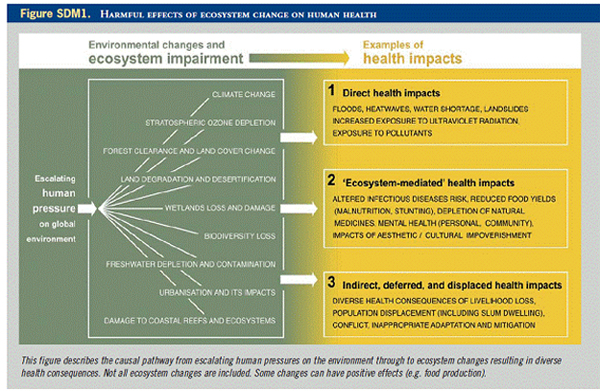
Figure 1. Harmful effects of ecosystem change on human health (from the Millennium Ecosystem Assessment “Ecosystems and Human Well-being: Health Synthesis;”http://www.millenniumassessment.org/documents/document.357.aspx.pdf
[Permission granted to reproduce World Health Organization item/s September 23, 2010 by WHO, Dolores Campanario, Geneva,Switzerland.]
To learn more, the following websites hold a wealth of information:
· Millennium Ecosystem Assessment
o http://www.millenniumassessment.org/en/index.aspx
· Center for Global Health and the Environment
o http://chge.med.harvard.edu/index.html
· Center for Sustainability and the Global Environment
o http://www.sage.wisc.edu/
· The World Health Organization
o Climate Change and Human Health studies: http://www.who.int/globalchange/en/
o Health and Environment Linkages project : http://www.who.int/heli/en/
o Environmental burden of disease: http://www.who.int/quantifying_ehimpacts/publications/preventingdisease/en/index.html
· Intergovernmental Panel on Climate Change, Fourth Assessment Report, 2007, Human Health Chapter
o http://www.ipcc.ch/publications_and_data/ar4/wg2/en/ch8.html
· IUCN Ecosystems and Human Wellbeing
o http://www.iucn.org/what/tpas/livelihoods/
· UNEP and WHO’s Libreville Declaration on Health and Environment collaboration
o http://www.unep.org/health-env/pdfs/libreville-declaration-eng.pdf
· Cooperation on Health and Biodiversity (COHAB)
o http://www.cohabnet.org/
· Convention on Biological Diversity (CBD)
o http://www.cbd.int/
· Intergovernmental Science-Policy Platform on Biodiversity and Ecosystem Services (IPBES)
o http://ipbes.net/
Meredith A. Barrett is a PhD candidate in the University Program in Ecology at the Nicholas School of Environment at Duke University, Durham, North Carolina (USA). She is working to identify health consequences of human development on lemur populations in Madagascar. Ms. Barrett, along with Aaron Stoertz, coordinate the Global Health Working Group, a student-run interdisciplinary forum at Duke University dedicated to educating students about global health issues.
Aaron Stoertz is pursuing his MSc in Global health at Duke Global Health Institute and has a certificate in epidemiology from the University of North Carolina’s Gillings School of Global Public Health. Mr. Stoertz’s current focus is human resources for health and health are distribution in underprivileged communities and nations.
Timothy Bouley is currently studying global health adaptation to climate change while pursuing degrees in medicine at Duke University and environmental change at Oxford University, United Kingdom. |
|
| CAPRINE ARTHRITIS/ENCEPHALITIS - PHILIPPINES: COMPARATIVE MEDICINE ASPECTS - ProMED Post - Tuesday, September 21, 2010 |
CAPRINE ARTHRITIS/ENCEPHALITIS - PHILIPPINES: COMPARATIVE MEDICINE ASPECTS
Please see a notable One Health ProMED-mail posting on One Health Initiative Website ProMED Page - Tuesday, September 21, 2010.
http://www.onehealthinitiative.com/promed.php
http://www.promedmail.org/pls/apex/f?p=2400:1001:4788988141084359::NO::F2400_P1001_BACK_PAGE,F2400_P1001_PUB_MAIL_ID:1000,84924
|
|
| One Health Advocate/Supporter Website Promotes Global Cancer Awareness - Monday, September 20, 2010 |
One Health Advocate/Supporter Website Promotes Global Cancer Awareness
A recent global call to action is now promoted on the “Millennium Medicine Project Global Cancer Initiative” of the Humanitarian Resource Institute. This website’s One Health advocacy http://www.humanitarian.net/biodefense/fazdc/zdc1/ was previously reported on a One Health Initiative website News item April 24, 2010 (scroll down).
While scrolling down, please note the specific One Health Cancer News items highlighted, e.g. the first item under this announcement: “One Health in ACTION: Human Breast Cancer Comparative Medicine Research Advances at MD Anderson Cancer Center”.
Two of many cancer references of interest:
1. Head and Neck Program at Smilow Cancer Hospital and the Yale School of Medicine. http://www.yaleheadandneck.org/
2. Cancer - Key Facts: World Health Organization. http://www.who.int/mediacentre/factsheets/fs297/en/index.html |
|
| One Health in ACTION: Human Breast Cancer Comparative Medicine Research Advances at MD Anderson Cancer Center - Friday, September 17, 2010 |
One Health in ACTION: Human Breast Cancer Comparative Medicine Research Advances at MD Anderson Cancer Center
Physicians, PhDs, and Veterinarians working collaboratively and synergistically
Department of Veterinary Sciences, Michale E. Keeling Center for Comparative Medicine and Research, The University of Texas
Provided September 13, 2010 by:
Christian R. Abee, DVM, MS, DACLAM
Doctor R. Lee Clark Professor and Chair
Department of Veterinary Sciences
Director, Michale E. Keeling Center for Comparative Medicine and Research
University of Texas MD Anderson Cancer Center
Bastrop, TX 78602
Email: cabee@mdanderson.org
Telephone: (512) 321-3991
Research at the Keeling Center has led to discovery of new breast cancer therapeutic monoclonal antibodies, and the development of early breast cancer tests based on the antibodies. These antibodies were discovered in the laboratory of Keeling Center investigator Dr. Feng Wang-Johanning [MD, PhD] and her Keeling Center collaborator, Dr. Gary Johanning [PhD]. The monoclonal antibodies are directed against an ancient retrovirus that originated outside the human body as a remnant of an exogenous retrovirus, and subsequently became incorporated into the genome of primates millions of years ago. This retrovirus, termed human endogenous retrovirus (HERV), currently resides in the genome of all humans.
Dr. Wang-Johanning and Dr. Johanning are focusing their studies on one highly active subgroup of HERV, HERV type K. HERV-K is not usually expressed in normal, non-cancer cells, but they found that its expression re-emerges in human breast cancer, making it a good target for antibody therapy. Dr. Wang-Johanning’s major research discovery to date is that monoclonal and single chain antibodies against HERV-K are effective in inhibiting breast cancer cell proliferation and inducing cell cycle arrest and apoptosis, both in vitro and in vivo. Pivotal studies in immunodeficient mice demonstrated that tumor sizes were significantly reduced, and onset of tumorigenesis was significantly delayed, in antibody-treated mice bearing breast tumors.
HERV-K is thus a novel antigen target for breast cancer, and Dr. Wang-Johanning’s pre-clinical studies provide compelling evidence that antibodies to HERV-K have the potential to be effective therapeutic agents for treating breast cancer. She is currently developing humanized and human antibodies for clinical trials, aimed at translating her laboratory results to breast cancer patients. Drs. Wang-Johanning and Johanning are hopeful that this antibody will rival the effectiveness of the well-known breast cancer therapeutic antibody Herceptin. There is reason for their optimism, because while Herceptin is effective against only 25-30 percent of breast cancers, anti-HERV-K antibodies have the potential to be effective against almost all human breast cancers.
The research of Dr. Wang-Johanning and collaborators has just taken an exciting turn. They are taking advantage of the presence of HERV-K in breast cancer to develop early breast cancer tests. These tests are based on detection of anti-HERV-K serum antibodies and viral RNA, and will be analogous to the PSA test that is widely used for prostate cancer screening. There is a need for these tests, because currently there are no sensitive and specific serum tests for breast cancer.
These discoveries would not have been possible without “One Health” collaboration between Dr. Wang-Johanning’s group and investigators at the main M. D. Anderson Cancer Center campus in Houston. Kelly Hunt, MD, breast cancer surgeon, provided breast cancer serum and tumor tissues for Dr. Wang-Johanning’s projects. In addition, Stephan Ambs, PhD, National Cancer Institute, is collaborating with Dr. Wang-Johanning’s laboratory to assess the clinical significance of elevated HERV-K in breast cancer. Bruce Bernacky, DVM at the Keeling Center, will also play a prominent role in upcoming studies with Dr. Wang-Johanning because he will provide access to primates for testing her antibodies prior to human clinical trials.
________________________________________________
Note: Please see the current issue of the Institute of Laboratory Animal Research (ILAR) Journal which contains “One Health: The Intersection of Humans, Animals and the Environment – Scientific Editor: James G. Fox, DVM, MS [2010 Volume 51, Number 3]
http://dels-old.nas.edu/ilar_n/ilarjournal/51_3/html/
ILAR Journal and ILAR e-Journal
The National Academies
500 Fifth Street, NW
Washington, DC 20001
202-334-2590
202-334-1687 fax
ILARJ@nas.edu
Cameron Fletcher, Managing Editor cfletcher@nas.edu” |
|
| A One Health Challenge - An Innovative Approach to Graduate Public Health Education - Tuesday, September 14, 2010 |
A One Health Challenge
An Innovative Approach to Graduate Public Health Education
The Master of Public Health (MPH) Program at Kansas State University in Manhattan, Kansas (USA) is not what one would normally expect from graduate public health education. While a few other Master of Public Health programs in the United States are aligned with a College of Veterinary Medicine, K-State’s program is housed in one. And, four other colleges on the campus are partners to make it truly interdisciplinary.
Started in the fall semester of 2003, the Kansas State MPH Program was initiated as a collaboration of the Graduate School and the Colleges of Agriculture, Arts & Sciences, Human Ecology, and Veterinary Medicine, with the first interim director from Human Ecology. This innovative approach was both cost effective and efficient with its use of existing infrastructure, faculty and courses. Today, the college partners are still the same, and the program has its first full-time Director, Mike Cates, DVM, MPH, also a Professor in the College of Veterinary Medicine. Dr. Cates is the former Chief of the Army Veterinary Corps and the first veterinarian to serve as the Commanding General of the Army’s main public health organization, the Center for Health Promotion and Preventive Medicine as well as the Surgeon General’s primary senior executive on Preventive Medicine and Public Health.
The partnership, crossing traditional college boundaries at Kansas State University, has a definite advantage for students. There are over 55 different faculty members affiliated with the MPH Program, from 8 departments in the 4 participating academic colleges. This variety of disciplines and research interests opens a wealth of possibilities for students, who, despite the newness of the program and the relatively small size, can choose between four distinct areas of emphasis—Infectious Diseases and Zoonoses; Food Safety and Biosecurity; Public Health Nutrition; and Public Health Physical Activity. Dr. Cates noted “The faculty members here are extraordinary experts in many different areas which impact on animal, human and/or environmental health. You will probably not find such a unique blend anywhere else.”
That uniqueness and breadth has led to significant growth in enrollment. When Dr. Cates arrived in January 2009, the program had an enrollment of 26 students; today, there are 75. One noticeable trait of the program is the high interest level of veterinarians, veterinary students and even pre-professional students to pursue the MPH degree or the Graduate Certificate in Public Health Core Concepts. Right now, over half of the MPH students fit into one of those veterinary-related categories. Overall, the program has attracted outstanding domestic and international students from over 15 disciplines, including medicine, nursing, dentistry, human nutrition, kinesiology, animal science, food science and several others, from 17 states and 11 different countries.
The future looks bright for even more opportunities for students and graduates of this program, with the arrival of two major federal laboratories—the National Bio and Agro-Defense Facility and the Arthropod Borne Animal Disease Research Unit—a continuing and growing culture of teamwork across the state. The program is exploring ways to collaborate with the University of Kansas’ more traditional program, and the two universities already play active roles in the state’s Public Health Systems Group, involving local and state governmental agencies along with foundations and other health-related stakeholders, and the Public Health Workforce Development Group. In another example, Kansas State MPH faculty and students help in public health outreach, education and research with the university’s One Health Kansas and Pathways to Public Health initiatives, aiming to raise awareness and interest in public health, starting with children in kindergarten, and ultimately to improve the numbers and quality of educated professionals in the public health workforce.
A crucial component of the tremendous growth of the K-State MPH Program is the interest, advocacy and support from the university’s administrative leadership, particularly the college deans and the past and present university provosts and presidents. “Without the consistent and adequate support of the university and the college leaders, such an innovative interdisciplinary approach to education would not succeed,” Dr. Cates noted. “We are very fortunate here to have visionaries who are willing to fund non-traditional approaches in a field where multidisciplinary methods really make the most sense. Prevention is the best way to health, and collaboration is key. Together, we must set a ‘one health’ example among all stakeholders, for improved community health throughout our state and beyond.”

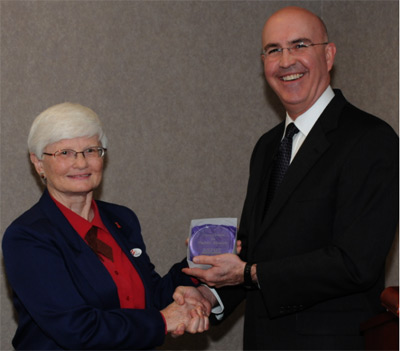
Dr. Carol Ann Holcomb, first Interim Director of MPH Program, receiving Excellence in Public Health Award from Dr. Mike Cates.

Mike Cates, DVM, MPH, current Director, MPH Program
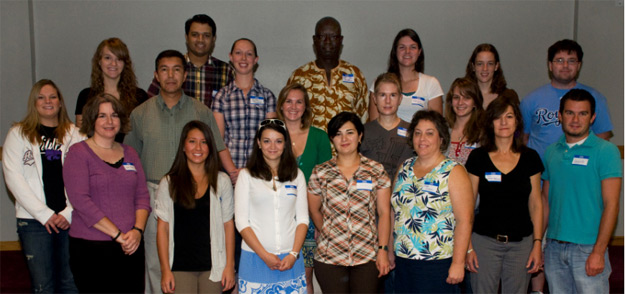
New MPH and Public Health Graduate Certificate Students for Fall 2010

Picture from campus
|
|
| One Health Poster Representation at Farm Foundation Symposium by Two Department of Homeland Security Centers of Excellence - Thursday, September 09, 2010 |
One Health Poster Representation at Farm Foundation Symposium by Two Department of Homeland Security Centers of Excellence
Titled: “One Health – One Medicine – One Environment”
Two outstanding Department of Homeland Security Centers of Excellence—the Center of Excellence for Emerging and Zoonotic Animal Diseases (CEEZAD), Kansas State University and National Center for Foreign Animal and Zoonotic Disease Defense (FAZD), Texas A & M University, will jointly present One Health posters at the Farm Foundation Symposium in Washington, D.C. on September 23rd and 24th, 2010. They will be titled “One Health-One Medicine-One Environment” to help reflect the interdisciplinary, all inclusive approach offered by One Health principles for health and health care problem solving.
The two-day interdisciplinary symposium’s topic is “Zoonoses: Understanding the Animal Agriculture and Human Health Connection.” The program is targeted at a broad cross-section of people, including public health officials, veterinarians, physicians, virologists, agricultural producers, public policy makers and media representatives. For the conference program and registration details see: www.farmfoundation.org.
Both FAZD Center (http://fazd.tamu.edu), headquartered at Texas A&M University, and CEEZAD (http://sites.google.com/site/ceezad/home), headquartered at Kansas State University, seek to perform research and develop products that will defend the nation against high-consequence foreign animal and emerging/zoonotic diseases. Since at least 60 percent of all human pathogens originate in animals, the link between human medicine, veterinary medicine and our ecosystem is crucial for human health. There is also increasing awareness that in order to meet the One Health goal of uniting human and veterinary medicine, the impact of the environment is very important. Therefore, both Centers will develop a theme of “One Health-One Medicine-One Environment” in their Conference poster displays.
For further information please contact: Karinne Cortes at CEEZAD: email address
Kcortes@vet.k-state.edu telephone: 1-785-532-4614 or Lori Olivarez at FAZD: email address lrolivarez@ag.tamu.edu; telephone: 1-979-845-2855.
Note: The One Health Initiative website team strongly supports and applauds this collaborative approach for promoting the One Health concept.
|
|
| Two Important One Health Tuberculosis Articles – Published by “The International Journal of Tuberculosis and Lung Disease” - Wednesday, September 08, 2010 |
Two Important One Health Tuberculosis Articles – Published by “The International Journal of Tuberculosis and Lung Disease”
The International Journal of Tuberculosis and Lung Disease publishes articles on all aspects of lung health, including public health-related issues such as training programmes, cost-benefit analysis, legislation, epidemiology, intervention studies and health systems research. The IJTLD is dedicated to the continuing education of physicians and health personnel and the dissemination of information on tuberculosis and lung health world-wide.
Thoen C O, LoBue P A, de Kantor I. Why has zoonotic tuberculosis not received much attention? [Editorial]
http://www.ingentaconnect.com/content/iuatld/ijtld/2010/00000014/00000009/art00001 or directly to the pdf:
http://docstore.ingenta.com/cgi-bin/ds_deliver/1/u/d/ISIS/58527281.1/iuatld/ijtld/2010/00000014/00000009/art00001/7086BA00A165E4C012839704191CCE7B19C34A6FF6.pdf?link=http://www.ingentaconnect.com/error/delivery&format=pdf
LoBue P A, Enarson D A, Thoen CO. Tuberculosis in humans and animals: an overview [Serialised article. Tuberculosis: a re-emerging disease in animals and humans. Number 1 in the series]
http://www.ingentaconnect.com/content/iuatld/ijtld/2010/00000014/00000009/art00002 or directly to the pdf
http://docstore.ingenta.com/cgi-bin/ds_deliver/1/u/d/ISIS/58527321.1/iuatld/ijtld/2010/00000014/00000009/art00002/3B8E9C47DB8EA15012839705518C2A9210DED7F128.pdf?link=http://www.ingentaconnect.com/error/delivery&format=pdf
Website posting approval granted: September 8, 2010 |
|
| American Medical Association (USA) President Reaffirms Strong Support of One Health - Monday, August 30, 2010 |
American Medical Association (USA) President Reaffirms Strong Support of One Health
"The AMA strongly supports the One Health Initiative, the collaborative effort of multiple disciplines to attain optimal health for humans, animals, and our environment. More than 60 percent of human infectious diseases and the preponderance of emerging infectious diseases have an animal vector. Better collaboration is needed between human and veterinary medicine to protect the public health. The One Health Initiative is playing an important role in achieving this goal."
Cecil B. Wilson, MD, President,
American Medical Association
Message for posting on the One Health Initiative website received August 30, 2010 |
|
| A second good reason to attend the … “One Health” Session Scheduled for the North American Veterinary Conference (NAVC), in Orlando, Florida (USA) Monday, January 17, 2011 - Thursday, August 26, 2010 |
|
A second good reason to attend the …
“One Health” Session Scheduled for the North American Veterinary Conference (NAVC), in Orlando, Florida (USA) Monday, January 17, 2011 www.navc.com
Remember the first good reason to attend was described about and by Dr. Paul P. Calle. It was posted on August 13, 2011 (scroll down).
Here is a second outstanding featured speaker, an activist wildlife veterinarian:
Kirsten Gilardi, DVM, DACZM
Assistant Director, UC Davis Wildlife Health Center
School of Veterinary Medicine
University of California, Davis, CA (USA)
One Shields Avenue
Davis, CA 95616-8739
E-mail: kvgilardi@ucdavis.edu
Dr. Gilardi says she has directed her veterinary career towards One Health efforts, “whether that be providing clinical care to wildlife species endangered due to human-related activities, researching the health status of wildlife species as indicators of the health of their ecosystems, directing the One Health-focused Envirovet Summer Institute, or now administering the Mountain Gorilla One Health Program. As a wildlife veterinarian, a One Health framework for my endeavors is the most effective and only meaningful approach.” Dr. Gilardi said, “it is highly rewarding on a professional and personal level.”
Speech topic: “One Health in ACTION” - DETECTING WILDLIFE ZOONOSES TO PREVENT HUMAN PANDEMICS
Dr. Gilardi describes her excellent and illuminating One Health message:
“The United States Agency for International Development (USAID) Emerging Pandemic Threats Program (EPT) is a recently launched international effort to detect emerging wildlife zoonoses in time to prevent human pandemics. The EPT is an excellent example of One Health in Action; in particular, its PREDICT project http://www.vetmed.ucdavis.edu/ohi/predict/index.cfm, is administered by the UC Davis Wildlife Health Center in partnership with Wildlife Conservation Society, Wildlife Trust, Global Viral Forecasting, Inc. and the Smithsonian Institution. It is working on the ground on the One Health frontline, conducting wildlife zoonoses and emerging disease surveillance in more than two dozen countries at high-risk wildlife-human interfaces such as bushmeat hunting and wildlife ecotourism.”
In coming months, the One Health Initiative website will feature other topics to be discussed by individual speakers in the NAVC scheduled Orlando, Florida (USA) One Health session.
Private practicing veterinarians, physicians and other health scientists in the U.S., Canada and worldwide are urged to consider attending. These issues are expected to impact each of you as the One Health movement continues to exponentially expand globally.
|
|
|
|
|
|
|
|


