|
|
 |
|
One Health News |
| |
|
| |
| Found 1196 Matching Results. View archived News Here. |
|
|
|
| U.S. Food and Drug Administration (FDA) - "One Health: It's for All of Us" - Thursday, March 28, 2019 |
U.S. Department of Health and Human Services
U.S. Food and Drug Administration
10903 New Hampshire Avenue
Silver Spring, MD 20993
1-888-INFO-FDA (1-888-463-6332)
One Health: It’s for All of Us
“...The health of people, animals, and the environment is intertwined. A health hazard for people may likely be a health hazard for animals. For example, smoking is not only harmful to people; it’s harmful to pets too. Medical advances in understanding and treating a disease in one species, such as heart disease in people, may be applied to other species. And a change in the environment can affect all living things, from people to animals to plants.
The One Health Initiative recognizes this inter-connectedness and advocates a comprehensive approach to health and environmental problems versus a piecemeal approach. By building bridges between physicians, veterinarians, environmental scientists, and public health professionals, the initiative aims to “promote, improve, and defend the health and well-being of all species.”1
“No one discipline or sector of society has enough knowledge and resources to prevent emergence or resurgence of diseases in today's globalized world. Through mutual collaborations, veterinarians and physicians can accomplish so much more to advance the health of humans and animals,” said *Dr. Bernadette Dunham, former director of FDA’s Center for Veterinary Medicine. Dr. Dunham is currently a professor at the Milken Institute School of Public Health at George Washington University in Washington, D.C., where her focus is on One Health issues. ...” ...”
Page Last Updated: 03/18/2019
SEE: https://www.fda.gov/animalveterinary/resourcesforyou/animalhealthliteracy/ucm278139.htm
Note: *Member, One Health Initiative Advisory Board http://www.onehealthinitiative.com/advBoard.php
|
|
| Granite Geek: Broader response from health community on microbes is needed - Tuesday, March 26, 2019 |
| |
| |
| |
|
Granite Geek: Broader response from health community on microbes is needed
“This was impressive,” said Laura Kahn, a medical doctor who helps run a program called the One Health Initiative, about the fact that 270 medical ...
|
Note: Physician, Dr. Laura H. Kahn is a co-founder of the One Health Initiative team & website. |
|
| “Brucellosis in Goats and Sheep: An Endemic and Re-Emerging Old Zoonosis in the 21st Century” - free, open-access download - Monday, March 25, 2019 |
March 25, 2019
“This is the presentation of a “open access” book entitled “Brucellosis in Goats and Sheep: An Endemic and Re-Emerging Old Zoonosis in the 21st Century” which was just released.
It can be freely downloaded at https://novapublishers.com/shop/brucellosis-in-goats-and-sheep-an-endemic-and-re-emerging-old-zoonosis-in-the-21st-century/:
1) Add to cart; 2) complete the register form; 3) and a link for download will be soon sent to your email by the publisher).”
Courtesy of:
João Simões, DVM, PhD
http://orcid.org/0000-0002-4997-3933
Department of Veterinary Sciences-
University of Trás-os-Montes e Alto Douro.
Portugal
João Simões mailto:jsimoes@utad.pt; jsimoes.pt@gmail.com
Note: Dr. Simões et. al. published the landmark One Health book: “The Principles and Practice of Q Fever: The One Health Paradigm (2017) https://novapublishers.com/shop/the-principles-and-practice-of-q-fever-the-one-health-paradigm/”
|
|
| One Health Initiative team (OHI), One Health Commission (OHC) and 68 other Health Oriented Organizations sign Supporting Letter RE: “Pandemic and All-Hazards & Advancing Innovation Act (PAHPAI, H.R. 269)” to U.S. Congressional Leadership Today - Friday, March 22, 2019 |
One Health Initiative team (OHI), One Health Commission (OHC) and 68 other Health Oriented Organizations sign Supporting Letter RE: “Pandemic and All-Hazards & Advancing Innovation Act (PAHPAI, H.R. 269)” to U.S. Congressional Leadership Today
March 22, 2019
"On behalf of the undersigned organizations, representing public health, healthcare providers, emergency managers, environmental health, biotechnology innovators, and researchers, we are again writing to encourage you to advance the Pandemic and All-Hazards Preparedness & Advancing Innovation Act (PAHPAI, H.R. 269), which overwhelmingly passed the House of Representatives in January. A similar version passed the Senate Health Education, Labor & Pensions (HELP) Committee last year. The HELP and Energy & Commerce Committees have made tremendous, bipartisan progress on this important legislation, and it would be a setback for our national health security to further delay reauthorization. The disaster relief package being considered by Congress would be a logical vehicle for PAHPAI. ... "
SEE complete letter at: http://www.onehealthinitiative.com/publications/PAHPA%20sign-on%20letter%20to%20leadership%203%2022%2019.pdf
******************
Provided by:
Dara Alpert Lieberman
Director of Government Relations
Trust for America's Health
1730 M Street, NW, Suite 900
Washington, D.C. 20036
dlieberman@tfah.org
www.tfah.org
Please see previous OHI and OHC supportive NEWS items for this important legislative endeavor http://www.onehealthinitiative.com/news.php?query=PAHPA.
|
|
| European Journal for Dental Implantologists--Implementation of One Health in undergraduate education: Working together from curricula to practice - Tuesday, March 19, 2019 |
Originally published in EDI Journal 1/2019
European Journal for Dental Implantologists
www.teamwork-media.de/project/edi-journal
Implementation of One Health in undergraduate education
Working together from curricula to practice
One Health is a concept that recognises interlinks between human health, animal health and the environment. The value of the One Health holistic approach is undisputed when it comes to tackling different challenges to public and animal health.
Academics, students, professionals and policy makers were engaged in lively discussions about One Health in Paris on 5 December 2018. Participants exchanged their views about the value and necessity for working together on a common understanding of the One Health concept and on promoting interdisciplinary collaboration starting from universities.
The European associations representing medical doctors, dentists, veterinarians and their students – among the Council of European Dentists – remain committed partners for future actions to be undertaken towards the implementation of the One Health approach in education and practice and call on academics and policy makers at national and European level:
• to work on the development of a clear definition to ensure a common understanding of the One Health concept;
• to foster exchanges between medical, dental and veterinary schools under the One Health approach;
• to work together on One Health Competences;
• to support and ensure the continuation of this open debate;
• to support the further investigation of implementation of One Health interdisciplinary education of doctors, dentists and veterinarians.
Source: Council of European Dentists (CED)
Please see PDF http://www.onehealthinitiative.com/publications/edi_01_19_n_ced_one_low.pdf for full article.
Permission to post on One Health Initiative website granted March 19, 2019 by:
Isabel Lamberty ∙ Redaktion | Editor EDI Journal teamwork media GmbH ∙ Hauptstr. 1 ∙ 86925 Fuchstal ∙ Germany
Fon +49 8243 9692-32 ∙ Fax +49 8243 9692-22 ∙ i.lamberty@teamwork-media.de
www.teamwork-media.de ∙ www.teamwork-campus.de ∙ www.dental-bookshop.com ∙ pi.dental-online-channel.com
Geschäftsführer/Managing Director Uwe Gösling
Sitz der Gesellschaft Fuchstal | Amtsgericht Augsburg HRB 14984
|
|
| Press Releases - Food and Agricultural Organization (FAO), World Organization for Animal Health (OIE), and World Health Organization (WHO) launch a guide for countries on taking a One Health approach to addressing zoonotic diseases - Monday, March 11, 2019 |
OIE
World Organisation for Animal Health
Press releases
Food and Agricultural Organization (FAO), World Organization for Animal Health (OIE), and World Health Organization (WHO) launch a guide for countries on taking a One Health approach to addressing zoonotic diseases
Zoonotic diseases continue to be a threat to global health, causing millions of deaths and economic losses every year. To support countries to control these diseases, the Tripartite organisations (FAO, OIE and WHO) today launched a guide entitled ‘Taking a Multisectoral, One Health Approach: A Tripartite Guide to Addressing Zoonotic Diseases in Countries’.
Rome/Paris/Geneva, 11 March 2019 - Zoonotic diseases – those diseases that can spread between animals and people – continue to have major impacts on human health. Every year, nearly 60 000 people die from rabies, and other zoonotic diseases such as avian influenza, Ebola or Rift Valley fever constitute additional threats. These diseases do not only affect human health, but also animal health and welfare, causing lowered productivity (milk or egg quality and safety, etc.), or death, and consequently affecting farmers’ livelihoods and countries’ economies.
Diseases know no borders. As global trade and travel expands, zoonotic diseases are increasingly posing concerns worldwide. Every day, new health challenges emerge at the human-animal-environment interface. To face these threats, collaboration, coordination, communication, and concerted action between different sectors are needed, using a multisectoral, One Health approach. However, many countries lack the capacity to implement such collaboration.
To support countries in filling these gaps, the Food and Agriculture Organization of the UN (FAO), the World Organisation for Animal Health (OIE), and the World Health Organization (WHO) today launched a guide entitled ‘Taking a Multisectoral, One Health Approach: A Tripartite Guide to Addressing Zoonotic Diseases in Countries’.
Building multisectoral, One Health bridges to strengthen national capacities
This guide, referred to as the Tripartite Zoonoses Guide (TZG), provides principles, best practices and options to assist countries in achieving sustainable and functional collaboration at the human-animal-environment interface. It is flexible enough to be used for other health threats; for example, food safety and antimicrobial resistance (AMR). By using the TZG and its associated operational tools (which are currently being developed) countries can build or strengthen their national capacities in:
- Multisectoral, One Health coordination mechanisms
- Strategic planning and emergency preparedness
- Surveillance and information sharing
- Coordinated investigation and response
- Joint risk assessment for zoonotic disease threats
- Risk reduction, risk communication, and community engagement
- Workforce development
Options for monitoring and evaluating the function and impact of these activities are additionally included to support countries in their efforts to make improvements in their zoonotic disease frameworks, strategies and policies. Moreover, taking the One Health approach presented in the TZG helps countries to make the best use of limited resources and reduces indirect societal losses, such as impacts on livelihoods of small producers, poor nutrition, and restriction of trade and tourism.
By working collaboratively across sectors and disciplines, human and animal lives are saved, livelihoods are secured, and our global health systems are improved in a sustainable way. The Tripartite organizations encourage countries to use the TZG to achieve these goals by taking a One Health approach to address zoonotic diseases.
More information
Contact
- OIE: Catherine Bertrand-Ferrandis, Head of Communication Unit, media@oie.int , +33 1 44 15 19 72
|
|
| DUKE (USA) ONE HEALTH News - January 30, 2019 - Monday, March 04, 2019 |
DUKE ONE HEALTH News
Leptospirosis Study Update from the Field
By Jane Fieldhouse, MSc and Diego Gálan
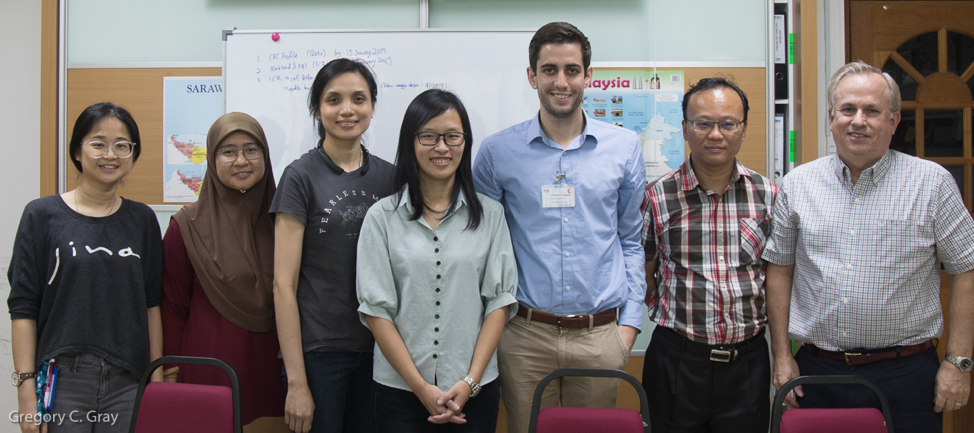
Leptospirosis study team at Sibu Clinical Research Centre (left-to-right Ms. Jakie Ting, Ms. Kamilah Dahian, Dr. Wendy Lee, Ms. Tiing Tiing Chua, Diego Gálan, Dr. Teck-Hock Toh, and Dr. Gregory Gray)
The Duke One Health team is working with collaborators across several hospitals in Sarawak, a state along the northwest coast of the island of Borneo, to improve early diagnosis of leptospirosis. Leptospirosis is a zoonotic disease with symptoms similar to those of other tropical infectious diseases such as malaria. Leptospirosis most commonly presents as an acute febrile illness, though severe and potentially fatal manifestations can occur.
The study will enroll patients at Sibu and Kapit Hospitals, where clinicians currently rely on rapid diagnostic tests as their only means of diagnosing leptospirosis. However, physicians in hospitals have become aware of the poor sensitivity and specificity of these tests. In order to obtain a reliable diagnosis, physicians in Sarawak must send patient samples to Kuala Lumpur, where a MAT analysis is performed. However, results from external testing take approximately 2-4 weeks to which often is not useful to individual patients.

Diego Gálan, a third-year medical student at Duke University, is conducting the leptospirosis study with Malaysian collaborators
The study aims to enroll 150 patients with clinical symptoms consistent with leptospirosis infection. Consenting patients will be asked to complete a survey capturing demographic information that will help us better understand the risk factors associated with this infection. Furthermore, blood and urine samples from the enrolled patients will be analyzed using a common rapid diagnostic test, a commercial ELISA assay, and a newer molecular assay. The US and Malaysian investigators will compare the sensitivity and specificity of the different tests and analyze the feasibility of implementing the new diagnostic tests in the hospitals in Sarawak. This project will hopefully improve the diagnostic power of the hospitals in Sarawak resulting in improved patient care. A better understanding of molecular and serologic epidemiology of leptospirosis, as well as understanding of alternative etiologies in acutely febrile patients, is important for determining health protection decisions and better-defining risks for exposure.
Support for this work comes from US Navy Medical Research Center – Asia.
|
|
| The U.S. Centers for Disease Control and Prevention (CDC) Field Epidemiology Manual - Epidemic Intelligence Service (EIS) - Sunday, February 24, 2019 |
The U.S. Centers for Disease Control and Prevention (CDC) Field Epidemiology Manual - Epidemic Intelligence Service (EIS)
Edited by Sonja A. Rasmussen and Richard A. Goodman
The CDC Field Epidemiology Manual is a definitive guide to investigating acute public health events on the ground and in real time. Assembled and written by experts from the CDC as well as other leading public health agencies, it offers current and field-tested guidance for every stage of an outbreak investigation—from identification to intervention and other core considerations along the way.
SEE: https://www.cdc.gov/eis/field-epi-manual/index.html?fbclid=IwAR1bZ92n2WYmZ5qKOBG-jtLkTzISQoF_ZXRRqaeAo7W-bOtfOfVK-Mf2CJI
|
|
| U.S. Centers for Disease Control and Prevention (CDC) - Q Fever Fact Sheets Available in Six Languages - Thursday, February 21, 2019 |
|

|
|
Centers for Disease Control and Prevention | National Center for Emerging and Zoonotic Infectious Diseases | One Health Office
|
|
|
|
Q Fever Fact Sheets Available in Six Languages
Did you know that CDC now has Q fever fact sheets available in six languages: English, Spanish, Arabic, French, Vietnamese, and simplified Chinese? The fact sheets provide quick information about Q fever, including who is at risk, signs and symptoms, and how to protect yourself. These fact sheets are available FREE on CDC’s Q fever website.

|
|
|
|
|
|
|
Find updates about One Health, new resources, and more on our website and follow @CDC_NCEZID on Twitter.
Footnote from One Health Initiative team: An additional important available resource text...
The Principles and Practice of Q Fever: The One Health Paradigm (2017)
https://novapublishers.com/shop/the-principles-and-practice-of-q-fever-the-one-health-paradigm/
|
|
| Duke One Health researchers: Planes, Trains and Viruses: How Transit Air Might Predict the Next Outbreak - Wednesday, February 20, 2019 |
Planes, Trains and Viruses: How Transit Air Might Predict the Next Outbreak
Duke One Health researchers are using bioaerosol sampling—that is, testing airborne particles—to start chipping away at this question. Their hope is ...
|
|
|
|
|
|
|


