|
|
 |
|
One Health News |
| |
|
| |
| Found 145 Matching Results. View current News Here. |
|
|
|
| New Zealand Centre for Conservation Medicine (NZCCM) – Auckland...One Health Supporter - Friday, October 16, 2009 |
ONE HEALTH SUPPORTER…
New Zealand Centre for Conservation Medicine (NZCCM) – Auckland
Officially opened on August 10, 2007
http://www.aucklandzoo.com/Homepage/Explore-The-Zoo/Conservation-Medicine-Centre/
The One Health Initiative website was notified October 16, 2009 that the NZCCM is a One Health supporter.
Provided by:
Richard Jakob-Hoff, BVMS, MACVSc (Wildlife Medicine)
Senior Veterinarian – Conservation & Research
New Zealand Centre For Conservation Medicine
Auckland Zoological Park
Private Bag, Grey Lynn, Auckland
New Zealand
|
|
| National Association of State Public Health Veterinarians links website to One Health Initiative website - Tuesday, October 13, 2009 |
The National Association of State Public Health Veterinarians (NASPHV) http://www.nasphv.org/ helps direct and develop uniform public health procedures involving zoonotic disease in the United States and its territories.
The NASPHV, a longstanding One Health supporter, now offers a link to the One Health Initiative website: http://www.nasphv.org/links.html |
|
| Ultrasound Discovery of the 20th Century – Unheralded as One Health Example & Today - a similar 21st Century One Health Model - Wednesday, October 07, 2009 |
Ultrasound Discovery of the 20th Century – Unheralded as One Health Example
http://www.ob-ultrasound.net/jjwild.html [1982 Press Release]
John J. Wild, MD (physician) and William Reid, PhD (Electrical Engineer): working as an interdisciplinary team, Drs. Wild and Reid discovered and built the ultrasound instrument used commonly today to diagnose cancer in humans [and animals].
Dr. Wild died September 18, 2009 according to a New York Times (USA) obituary today, October 7, 2009:
http://www.nytimes.com/2009/10/07/health/07wild.html?_r=1&ref=obituaries
_________________________________
Today - a similar 21st Century One Health Model
The One Health Initiative website has previously reported Orthopedic Surgeons (a veterinarian and physician) Research Creative Hip and Knee Replacements for Dogs and Humans Together - Wednesday, June 03, 2009: “Veterinarian James "Jimi" Cook, DVM, PhD, a University of Missouri- Columbia college of veterinary medicine professor of orthopedic surgery and physician B. Sonny Bal, MD, JD, MBA, Associate Professor of Orthopedic Surgery college of medicine have collaborated for over seven years on efforts to create hip and knee replacements without using commonplace biomechanical metal and plastic materials. The technique being developed by Dr. Cook for dogs initially, involves use of laboratory grown tissue (cartilage) that can be molded into replicas of joints that require replacement. Drs. Bal and Cook are concomitantly developing a process whereby a similar process can be adapted for humans.”
http://www.columbiamissourian.com/stories/2009/06/02/mu-research-may-lead-treatment-lou-gehrigs-disease/ |
|
| Florida State Department of Health = One Health MS Power Point Presentation - Sunday, October 04, 2009 |
Florida State Department of Health
Environmental Health Press Release – April 13, 2009
|
|
| A Unique One Health Perspective - Monday, September 28, 2009 |
A Unique One Health Perspective
Individuals holding degrees in veterinary medicine (DVM/VMD) and human medicine (MD)
See comments below by Leonard C. Marcus, VMD, MD, Larry R. Anderson, DVM, MD, Carey L. Renken, MD, (DVM Candidate), Steven W. Atwood, VMD, MD, MRCVS, MPH (Candidate) and Stephen F. Badylak, DVM, PhD, MD.
|
Quoted from an ‘introduction to One Health’ speech presented January 11, 2008 to a group of retired and semi-retired physicians at the Sarasota(Florida, USA) Friendship Center (by Bruce Kaplan, DVM):
“John McFadyean’s first love was veterinary medicine, receiving his veterinary medical diploma from Edinburgh veterinary school in 1876. He graduated from medical school in 1882 and received his science degree in 1883. McFadyean wanted degrees in Medicine and Science to prepare himself for an academic career in pathology and microbiology, grounded in the work of Robert Koch and Louis Pasteur. Although enthralled with the genius and discoveries of Koch, e.g. the famous Koch’s postulates … McFadayean respectfully challenged Koch’s erroneous assertion that Bovine TB was of little, if any concern, in its transmission to humans via milk and milk products. Over a ten year span, Dr. McFadyean was proved correct and he was subsequently knighted in 1905 for his service to veterinary science and agriculture and for his brilliant work on the royal commission on TB. He devoted his life to teaching pathology and anatomy, developing the field of veterinary research and administering the London veterinary school. To this day, laboratory diagnosis of Anthrax can be confirmed by demonstrating the organism in blood, lesions or discharges using McFadyean’s methylene blue stain for the bacillus capsule.”
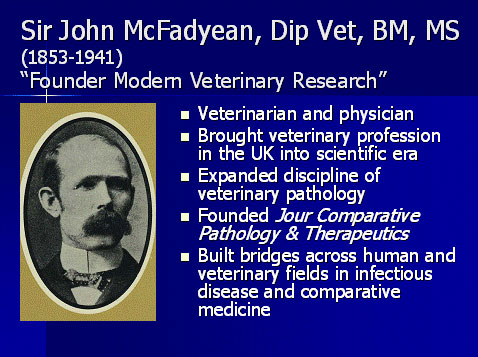
Slide by Thomas P. Monath, MD
1. Pattison, I. John Mcfadyean, Founder of Modern Veterinary Research. J.A. Allen 1981.
2. Dunlop, R.H. & Williams, D.J. 1996. Veterinary Medicine: an illustrated history.
Mosby, New York. Pp. 399-401.
Comments from modern day professional descendents of Dr. McFadyean…
Dr. Leonard C. Marcus on September 18, 2009:
“One medicine” [now referred to as One Health] is a valuable theoretical concept. Its value and practical limitations are outlined in a presentation I gave at the North American Veterinary Conference in 2004 and published under the title, Physician-Veterinarian Interaction: Why Do We Need It, How Can We Do It? in Bayer Zoonosis Symposium, supplement to Compendium on Continuing Education for the Practicing Veterinarian, vol. 26, No. 5a, 2004, pages 8-11. This article reflects my current thoughts and feelings about this issue.
I initially became a veterinarian as a way to combine my interest in biology and medicine. I became increasingly interested in specific aspects of comparative medicine, including evolution of pathogens and host response to them. I also developed an interest in parasitology and zoonoses and ultimately decided I wanted to care for human patients in these areas. My veterinary medical background gave me unique insights and was invaluable in my professional work.
Leonard C. Marcus, VMD, MD
1555 Commonwealth Av
Newton, MA 02465-2800
|
______________________________________________
Dr. Larry R. Anderson on September 22, 2009:
“I fully support One Health because it is the RIGHT THING TO DO! Resources are limited and only by fulfilling the One Health Mission of collaborative efforts will we, as a society, be able to feed a growing world population and also help protect the health of people, animals, and the environment.
As a young boy I had a love of farm life. My farm animals-exposure to exceptional veterinarian role models and a family tradition at Kansas State University shifted my career choice from considering human medicine to veterinary medicine. As the only veterinarian (D.V.M.) at a U. S. Air Force base, my work with 26 physician colleagues caused me to again re-consider a career in human medicine. Since obtaining my medical degree (M.D.), I have greatly enjoyed the rural general/family practice of medicine. Training in veterinary medicine provided a useful knowledge base and stepping stone toward my pursuits in becoming a family practice physician taking care of people.”
Larry R. Anderson, DVM, MD
Sumner County Family Care Center, PA
1323 North A
Wellington, KS 67152
________________________________________________
Dr. Carey L. Renken on September 23, 2009:
I was a die-hard student, resident and pediatric practitioner (pediatrician). I had no concept of “rest” or identity outside of medicine. However, I experienced a severe depression in the early 2000’s and, encountered serious emotional difficulties that anyone suffering from that illness can certainly understand as do physicians who treat depression patients.
During this trying period, I had a unique experience with my 1 year-old Cavalier King Charles Spaniel, Sophiel. She seemed to sense not only my distress, but appeared to know when and what to do to “intervene.” For instance, if my energy level was low enough not to get out of bed, Sophie would stand on my chest, put her face directly into mine and stare me in the face until I smiled or got up. If I ignored her she would tap my arm until I either smiled or got up. She never needed anything except to get me moving and smiling. For a “science-minded” professional it took me a long time to believe she could perceive such human complexities but I now have no doubt she saved my life.
After I recovered I decided to pursue veterinary medicine as a career. In particular, I began investigating the human-animal bond and was amazed at the growing number of people and organizations focusing on the H.A.B. The correlation between child/domestic abuse and animal abuse is compelling. I have also seen the use of amazing animal-assisted therapy with children and have great hope that this modality may be highly useful in treating disorders such as attachment disorders in adopted children and bonding for children with autism. Out of this knowledge I was also drawn to the issues of zoonoses and common toxicology issues-especially in light of the long standing and growing public opinion that pets are members of the family leading to closer physical contact between people and companion animals.
After reviewing the One Health Initiative website with its plethora of pertinent News and Publications items, I am now convinced that “One Health” represents the best hope for the future of health and health care for our society (worldwide)!
Carey L. Renken, MD (DVM Candidate)
1423 Roosevelt Avenue
Ames, IA 50010
Note: Dr. Renken earned her medical degree (MD) at the University of Nebraska, College of Medicine in 1994. She is currently a 3rd year student pursuing her DVM degree in the College of Veterinary Medicine at Iowa State University.
______________________________________________________
Dr. Steven W. Atwood on September 28, 2009:
The development and implementation of the One Health concept provides a formal outlet for the interdisciplinary exchange of ideas and information that was long overdue. Educational publications and launching of a One Health Initiative website by Drs. Tom Monath, Bruce Kaplan, and Laura Kahn are to be applauded.
In these times of contracting global resources, collaborative ventures that bridge disciplines that have been historically separated, seems a logical way to increase progress toward answering many of health cares most vexing questions.
From a young age I had always had an interest in both veterinary and human medicine having been exposed early on to relatives practicing in each field as well as to our own family veterinarian and family general practitioner, both of whom I admired greatly. So it was no surprise that after college I began studies at the University of Pennsylvania—a place where the One Medicine [now commonly referred to as One Health] philosophy was well developed, encouraged and promoted between the Schools of Veterinary Medicine, Medicine, Dental Medicine and Nursing.
In my case, the synergy of comparative medicine concepts were made real to me during the time, as a veterinary medical student, I was lucky enough to spend in the clinics and operating rooms of the Department of Orthopaedic Surgery in the School of Medicine. Pursuing degrees in veterinary medicine, medicine and now public health, has been my attempt to come as close as I could to completing a broad medical education that would allow me, in an interdisciplinary way, the option to explore various interests as they develop, here in the U.S. and/or elsewhere.
Steven W. Atwood, VMD, MD, MRCVS, MPH (Candidate)
Animal Health Care Associates, Ltd.
Martha's Vineyard Airport
Post Office Box 681
West Tisbury, Martha’s Vineyard,
Massachusetts, 02575
_______________________________________
Dr. Stephen F. Badylak on September 29, 2009
One Health is more than a collection of individuals, an organized approach to medicine, or a therapeutic strategy. One Health is a way of thinking about development, disease, diagnosis, and therapy. The better we understand evolution, mechanisms involved in the transmission of infectious disease, and biologic responses to pathogens and traumatic injury, the better we will be able to recognize the similarities in these fundamental concepts across species lines. One Health provides a forum for identifying and capitalizing upon these common features.
Stephen F. Badylak, DVM, PhD, MD
McGowan Institute for Regenerative Medicine
450 Technology Drive, Suite 300
Pittsburgh, PA 15219
_______________________________________
|
|
| NEWS RELEASE - Rabies is Still Deadliest Disease, Yet Preventable - Sunday, September 27, 2009 |
News Release
The Alliance for Rabies Control
For Immediate Release
Monday, September 28, 2009
Contact: Peter Costa
00 + 1.919.830.2199
peter.costa@worldrabiesday.org
Rabies is Still Deadliest Disease, Yet Preventable
Manhattan, KS, September 28, 2009 - Rabies is a disease with the highest case fatality rate of any known infectious disease. Rabies exists in every continent except Antarctica. Rabies has no boundaries and continues to spread across previously rabies-free countries (e.g., the recent news about dog rabies invading the tropical island paradise of Bali). Rabies kills humans regardless of their age, nationality, religion or cultural beliefs. In fact, rabies kills one person every ten minutes - more than 55,000 people every year. Sadly, over 50% of these deaths are children under 15 years of age.
Some of the facts about rabies in certain countries include: infected sheep brain vaccine is still used instead of modern vaccines; human rabies victims are sent home to die because it is cheaper to transport a live body than a dead body; and dog bite victims visit local healers where they are given worthless treatments including magic amulets or told to rub chili powder into their wounds as a cure for rabies. In order to address these issues and effectively reach across all continents, countries, religious backgrounds etc, the first World Rabies Day was established in Sept 2007 by a group of rabies experts that established the global foundation: The Alliance for Rabies Control (www.rabiescontrol.net).
Monday, Sept 28th will mark the third annual World Rabies Day (WRD). 10,000 visitors from over 150 countries come to the website (www.worldrabiesday.org) every month to download
educational messages to distribute in their own countries. For WRD this year, a multitude of events
will be held across the world in countries with opposing beliefs and diverse cultural backgrounds
including: Pakistan, India, Palestine, Israel, China, Taiwan and many more. In 2007, 74 countries
held a WRD event. In 2008, country participation increased 15% with 85 countries hosting activities.
The WRD initiative has engaged all of the major health organizations including the World Health
Organization (WHO), World Animal Health Organization (OIE), U.S. Centers for Disease Control and
Prevention (CDC) in Atlanta, all of the major Veterinary medical associations and many more
partners. World Rabies Day proves that dedicated partners working together to prevent a deadly
disease can ultimately overcome political barriers. Wishing everyone a brilliant and active World Rabies
Day on Monday, September 28th.
The Alliance for Rabies Control is the world's foremost non-profit organization dedicated to
raising global awareness towards human rabies prevention, canine rabies elimination and
wildlife rabies control. The Alliance strives everyday to keep millions of people around the world safe from rabies.
### |
|
| Judith A. Monroe, MD, Physician Health Commissioner of the Indiana State Department of Health Recently Announced New Assistant Commissioner, James Howell, DVM, MPH - Friday, September 25, 2009 |
Indiana State (USA) Epidemiologist— Public Health Veterinarian and One Health Supporter/Advocate—Accepts Position as Assistant Commissioner for the Public Health & Preparedness Commission
Judith A. Monroe, MD, Physician Health Commissioner of the Indiana State Department of Health http://www.in.gov/isdh/ Recently Announced New Assistant Commissioner, James F. Howell, DVM, MPH (see below):
,
I am pleased to announce State Epidemiologist James Howell, DVM, has agreed to serve as assistant commissioner for the Public Health & Preparedness Commission, effective today [Since August 2009].
In this role, Dr. Howell will oversee the following areas: the Public Health & Preparedness Commission includes Environmental Public Health, Epidemiology Resource Center, HIV/STD Division, Indiana Lead & Healthy Homes, Immunization, Local Health Department Outreach, Office of Legislative Affairs, Office of Primary Care, Public Health Preparedness & Emergency Response, and Tuberculosis Control.
Over the 13 years he has worked at the Department, Dr. Howell has shown exemplary professionalism and dedication to serving public health. I am certain he will become an even greater asset to the agency in his new role.
As state epidemiologist, Dr. Howell oversaw the day-to-day operations of Chronic Disease Epidemiology, Data Analysis, Food Protection, Geographic Information Services, Radiation Health, Surveillance and Investigation of Communicable Disease, as well as Zoonotic and Vector-borne Diseases. In addition to his current position, he has served as Director of Operations, Veterinary Epidemiologist, and as the Surveillance/Investigation Coordinator.
Dr. Howell has had a varied professional career in both private and public sector. He was a clinical practitioner for more than two years in mixed veterinary practices in north central Pennsylvania. He also served more than 24 years in the US Air Force in veterinary and public health roles at base level, Dept. of Defense level, and at Air Force Major Command Headquarters. His last military assignment was at the Air Force Material Command Surgeon’s Office, where he oversaw public health programs at 13 air force bases from Massachusetts to Florida to California and was the command’s senior advisor for officers in the Biomedical Science Corps.
Howell received his Doctor of Veterinary Medicine degree from Purdue University and his Masters in Public Health from the University of Michigan. He is a Diplomate of the American College of Veterinary Preventive Medicine. In addition to numerous military decorations and awards, Dr. Howell is a recipient of the Purdue University School of Veterinary Medicine’s Distinguished Alumni Award.
Judy Monroe, MD
|
|
| More Sophisticated, Better Coordinated Global System Needed To Effectively Prevent, Detect, Respond to Zoonotic Infectious Diseases - Wednesday, September 23, 2009 |
|
More Sophisticated, Better Coordinated Global System Needed
To Effectively Prevent, Detect, Respond to Zoonotic Infectious Diseases
|
The National Academy of Science, Institute of Medicine issued a press release on September 22 in support of the recently-issued report entitled "Sustaining Global Surveillance and Response to Emerging Zoonotic Diseases." This effort was funded by US Agency for International Development [USAID]; Dr. Marguerite Pappaioanou was the co-Chair of the committee.
See this link for the press release: http://www8.nationalacademies.org/onpinews/newsitem.aspx?RecordID=12625. This link will take you to report - to purchase or to read on-line for free: http://www.nap.edu/catalog.php?record_id=12625.
To access additional information regarding this project such as its charge; previous meeting agendas and presentations; and related reports; see: http://www.iom.edu/CMS/3783/54653.aspx
Tracy S. DuVernoy, DVM, MPH, DACVPM
Veterinary Medical Officer
Food and Drug Administration
Center for Food Safety and Applied Nutrition
Office of Food Defense, Communication and Emergency Response
Emergency Coordination and Response Team
[FDA CFSAN OFDCER ECRT HFS-015]
5100 Paint Branch Parkway, Room 2B-024
College Park, MD 20740-3835
Phone: 301-436-2248
Cell: 240-401-0788
Fax: 301-436-2633
Email: Tracy.DuVernoy@fda.hhs.gov |
|
| A “Twitter” account is now available on this One Health Initiative website Home page - Sunday, September 06, 2009 |
Started: August 25, 2009 (Tuesday)
Announcement:
A “Twitter” account is now available on this One Health Initiative website Home page or you may access it via https://twitter.com/OneHealthNews.
** Access to this feature has been temperamental. If so, try again repeatedly 2 to 4 times... and/or later.) |
|
| Remembering a Great One Health Physician Giant in History … Richard E. Shope, MD - Sunday, August 23, 2009 |
Remembering a Great One Health Physician Giant in History …
Richard Shope, MD
Submitted by:
Russell W. Currier, DVM, MPH, Dipl. ACVPM
Executive Vice President 'Emeritus'
American College of Veterinary Preventive Medicine
1864 NW 151 Court
Des Moines IA 50325-7850
Cell (515) 710-2331; home (515) 987-5541
Email: ruscurrier@yahoo.com
In honor of the late great physician researcher, Dr. Currier presents a list of Dr. Shope’s crucial historical contributions to medical and veterinary medical science.
Summary of Richard Edwin Shope Contributions to One Medicine/Health
Richard E. Shope MD (Dec 25, 1901 – October 2, 1966) was one of the pioneer microbiologists to investigate a variety of human and animal diseases and merits recognition for his many accomplishments that supported later research that continues to this very day. Dr Shope graduated from medical school at The University of Iowa in 1924 and immediately remained on staff there to teach pharmacology and work on the chemotherapy of tuberculosis. Shortly afterward he was invited to join the laboratories of the Rockefeller Institute at Princeton to work with Dr Paul Lewis, the discoverer of polio virus. Subsequently in 1928, he left tuberculosis research to investigate hog cholera in the field where he observed his first outbreak of swine influenza. Later research on influenza resulted in isolation of the virus from pigs and its co-pathogen Haemophilus influenzae suis, and subsequent research that postulated that the swine virus was related to the human 1918 pandemic virus.
Dr Shope acknowledged the influence of the legendary Dr Theobald Smith, at the Rockefeller Institute, on his own career and observed that Smith “although possessed of great imagination and … uncanny foresight, was a meticulously methodical worker, who abhorred the waste of anything – time, material, or animals.” This set a pattern for Shope’s career and an informal distillation of his key accomplishments are summarized in the bullet form.
- From Bernard Easterday, 4th Int’l Symposium on Emerging and Reemerging Pig Diseases, Rome June, 2003: “It remained for Shope to present the first reliable experimental evidence that influenza is caused by a virus (15). [Year 1931.] He demonstrated that he could reproduce swine influenza under strict experimental conditions by inoculating both filtered and unfiltered material from affected pigs into the respiratory tract of normal pigs. The disease produced by the filtered material was mild (later sometimes referred to as “filtrate disease”) but it could be transmitted repeatedly in this manner. Subsequently, Shope would describe swine influenza as a “… disease of complex etiology, being caused by infection with the bacterium H. influenzae suis and the swine influenza virus acting in concert.” Three years after Shope reported the viral nature of SI, Andrewes and Laidlaw (15) would report the viral nature of influenza in human beings. [Ref: Shope, RE 1964 Swine Influenza, In Diseases of Swine 2nd Ed. Ed by H.W. Dunne. P. 109-126.]
Note: Shope and Christopher Andrewes became very good friends and Shope collaborated with the UK investigators on techniques to isolate virus which they subsequently did utilizing ferrets and Andrewes and co-investigators, Smith and Laidlaw, were later knighted for this accomplishment.
- 1936-1937. Shope postulated linkage between human and swine influenza. [Laidlaw also advanced same idea at same time.]
- 1941. Shope postulated linkage of “masked or occult” viral infection of pigs with swine lung worm and its intermediate host, earth worms. This was very controversial and was not entirely corroborated. The issue became a moot point as husbandry of pigs was changing that precluded importance of this postulated cycle.
- From Sir Chrotopher Andrewes biographical memoirs: “In 1930 Shope’s attention was drawn to “mad itch” [aka pseudorabies], a violent distressing and fatal disease of cattle in the Midwest. He showed that it was caused by a virus transmissible to rabbits, and that it was endemic among pigs, in which it was comparatively harmless. Cattle contracted infection through contact with pigs. He finally proved the identity of cattle ‘mad itch’ with psedudorabies, a disease prevalent in parts of Europe. Later he studied another disease of pigs – swine pox – and showed that it could be, though it was not necessarily, transmitted through the agency of pig-lice. He also published evidence that hog cholera virus might persist, as swine flu virus appeared to do, in lungworms. Ref: Biographical Memoirs vol 50 (1979), p 353-375, © The National Academy of Sciences.
- Shope’s three most outstanding discoveries followed each other in rapid succession: swine influenza in 1931, the rabbit fibroma in 1932, and rabbit papilloma in 1933.”
- Andrewes again, “The work [masked rabbit papilloma virus studies by Shope] gained a new dimension when it was found that in many tame rabbits the warts progressed and became carcinomatous [sic]. This change, though common in domestic rabbits, was rare in cottontails. Shope at this time, was busy with many problems, so he generously gave the material to Francis Peyton Rous. What Rous did with the rabbit cancers during the next thirty years is a matter of history.” [Peyton Rous received Nobel Prize for Medicine in 1966 for work demonstrating viral etiology of cancer.]
- Viral etiology of cancer. Shope described papilloma in jack rabbits and the pathological condition bears his name “Shope papilloma [or fibroma]”, and in urban legend mode affected bunnies were referred to as “jack-a-lopes.” He prompted a colleague at Rockefeller Institute, Peyton Rous, to extend his inquiries to mammals. Rous had already demonstrated transmission in chickens but not mammals.
- During WW II, Shope was attached to the US Army and detailed to a joint Canadian-US project on Grosse Isle in St Lawrence River to develop a rinderpest vaccine for cattle. There was concern of biowarfare and deliberately introduced rinderpest would be a food production catastrophe. From Andrewes, “Here Shope, with a staff of five other scientists, worked in strict isolation, and in the course of nineteen months produced an effective vaccine by growing and attenuating the virus in hens’ eggs. This has since been used on a large scale in the field.”
- Shope was then transferred back to the Navy. He was in first party to set up a lab to study tropical diseases on Guam and on Okinawa after assault began. Shope was actually fired on. He found mold from Guam growing on photo of his wife Helen. He isolated a substance from this mold with in vivo antiviral properties and named it after wife “Helenine”. Later found to be nucleoprotein that stimulated interferon production.
- Approximately two years after WW II: Shope developed an effective vaccine to a South American rabbit disease that was deliberately introduced to Great Britain to reduce population and extensive burrowing of rabbits in farm fields. Inadvertent introduction in France however resulted in decimated rabbit populations and adverse effect on commercial rabbitries. Shope’s vaccine saved the rabbit industry in France.
- Circa 1950s: Shope isolated a second benign-tumor virus from deer. Also isolated the deer “hemorrhagic disease” virus.
- Later when Rockefeller closed the Princeton branch, Shope decided to leave and go to work for Merck in Rahway NJ. Subsequently he returned to Rockefeller in Manhattan [rented room during weekdays!] Later died from abdominal cancer October 2nd, 1966. During lifetime had two serious viral diseases, lymphocytic choriomeningitis and eastern equine encephalomyelitis.
- Andrewes, “ Shope received many honors. He was elected to the American Philosophical Society (1944) and the National Academy of Sciences (1940). He received honorary degrees from the universities of Utrecht, Rutgers, Giessen, Chicago, Pennsylvania, Iowa, and Yale, as well as many prizes and awards including the U.S. Army Legion of Merit and the Albert Lasker award.
- J of Amer Vet Med Ass’n, Nov 15, 1957. Editorial Comment entitled “Richard Shope, Benefactor of Animals.” “On May 8, 1957, the Association of American Physicians awarded the Kober Medal to Dr Richard E Shope, the second time this award has been given to a physician for contributions to the health of domesticated animals. The previous recipient was Dr. Theobald Smith.” [See Harvard Magazine, July-August 2009]
- Dr Shope acknowledged influence of individuals on his career specifically Theobald Smith, who worked out arthropod transmission of disease and Paul Lewis who discovered/isolated polio virus and died of yellow fever while studying the same disease in South America.
- “Dr Shope then paid tribute to a veterinary practitioner, Dr Fred J. Crow of Iowa City Iowa, “who permitted me to spend … time with him in the field…and who guided me during my initial experience with swine influenza…He got me my first case of swine pox and … of pseudorabies and …served as the connecting link between the practicality of the field and science of the laboratory.” Ref: JAVMA, Nov 15, 1957, p 486-487.
- The following excerpt is from the Souvenir Book published by the Eastern Iowa Veterinary Association on their 25th Anniversary (1913-1938). It was written by Richard E. Shope MD, of the Rockefeller Institute for Medical Research, Department of Animal and Plant Pathology, Princeton, New Jersey.
“In the summer of 1928, I was in Iowa doing blood counts in hog cholera and other swine diseases with the cooperation of a number of veterinarians in eastern Iowa. During that time I had occasion to go to Ames to see Dr Charles Murray and it was he who first called my attention to the existence of swine influenza. Returning to eastern Iowa, arrangements were made with Dr Fred Crow for the collection of material from typical cases when the epizootic should appear during the autumn. Dr Crow telegraphed me on November 13 saying, ‘Plenty of hog flu – come at once.’ I took the first train west, and on arriving in Iowa City found that there was indeed plenty of ‘hog flu.’ Through the friendliness and cooperation of a number of eastern Iowa veterinarians and their clients, many swine autopsies were obtained and material from the best cases was shipped back to Princeton. At that time, because we had no idea as to how fragile or easily killed the causative agent might be, we packed our infectious material in iced thermos jugs and sent it by air mail from Cedar Rapids. After several unsuccessful attempts to establish swine influenza in our experimental pigs in Princeton with the various samples sent, one batch finally ‘took.’ This had been obtained by Dr Crow on the Probst Brothers’ farm near Iowa City. Dr Lewis, my chief, wired me of his success in establishing the disease experimentally and to return to Princeton as soon as possible.”
- Richard and Helen Shope had four children and Richard’s scientific aptitude DNA went into the three sons. Richard Jr went to Cornell and got a DVM and later PhD in virology at University of Minnesota where I was acquainted with him. Son 2, Robert became the distinguished arbovirologist at Yale after medical school at Cornell; later moved to Galveston and now deceased. Son 3, became an academic pediatrician at the University of Michigan. Daughter attended college in Colorado and married well, and pursued equestrian interests, living happily ever after.
- Finally a quote from Dr Peyton Rous’ on the occasion of conferring The Academy Medal to Richard E. Shope, M.D. at the Annual Meeting of The New York Academy of Medicine, January 7, 1965: “Dr Shope’s theme throughout his scientific life has been the meaning of animal diseases for mankind, though he would never say so. Yet not alone from this theme has he drawn his wisdom and his strength. He knows human nature well. How does he value his fellow creatures including ourselves? Much as he does the lower animals – with understanding, indulgence, humor, and love.” Ref: Bull NY Acad Med, Vol 41, No 4, April 1965.
Russell Currier, 8/09 |
|
|
|
|
|
|


