|
|
 |
|
One Health News |
| |
|
| |
| Found 1196 Matching Results. View archived News Here. |
|
|
|
| June 8, 2018—American Public Health Association (APHA) Organizations’ letter to U.S. Congress Appropriations Committee leaders in support of strong investments in antimicrobial resistance in FY 2019 appropriations bills using ONE HEALTH APPROACH - Saturday, July 07, 2018 |
June 8, 2018—American Public Health Association (APHA) Organizations’ letter to U.S. Congress Appropriations Committee leaders in support of strong investments in antimicrobial resistance in FY 2019 appropriations bills using ONE HEALTH APPROACH
SEE: https://goo.gl/kaai5a
3rd paragraph,
“The report also highlights the need for continued and robust funding for AMR given that nationwide testing last year documented 221 cases of so-called “nightmare bacteria,” that can spread resistance to last-resort antibiotics. Robust, sustained investment in multi-agency One Health efforts is vital to combat AMR domestically and globally including prevention, antimicrobial stewardship, surveillance and data collection, research, and development of urgently needed new products including antimicrobial drugs, diagnostics, vaccines and alternative treatments.”
11th paragraph,
“Food and Drug Administration and US Department of Agriculture Experts agree that a One Health approach, including both human and animal health, is essential for combating antimicrobial resistance. We urge funding of $54 million for the Combating Antibiotic Resistant Bacteria initiative at FDA to support FDA’s efforts to address public health concerns associated with antimicrobial drug use in animals, and better protect antibiotic effectiveness for both human and animal populations. This funding is needed now more than ever, with estimates that antibiotic use in humans and livestock will rise by 50% before 2030. FDA would be able to better collaborate with consumers, producers, veterinarians, and other agencies to monitor AMR through the National Antimicrobial Resistance Monitoring System (NARMS) as well as other initiatives by the FDA Center for Veterinary Medicine to address AMR.”
Notably, see list of prominent organizational signatories:
|
Accelerate Diagnostics, Inc.
|
|
AdvaMedDx
Alliance for Aging Research
|
|
Alliance for the Prudent Use of Antibiotics
|
|
American Academy of Pediatrics
American Association of Avian Pathologists
|
|
American Association of Bovine Practitioners
American Public Health Association
|
|
American Society of Transplant Surgeons
|
|
American Society of Tropical Medicine & Hygiene
American Thoracic Society
American Veterinary Medical Association
|
|
Antibiotic Resistance Action Center, the George Washington University
Antimicrobials Working Group (Amplyx Pharmaceuticals, Aridis Pharmaceuticals, Arsanis Inc., Cidara Therapeutics Inc., ContraFect Corporation, Iterum Therapeutics Ltd., Melinta Therapeutics Inc., Motif Bio plc, Nabriva Therapeutics US Inc., Paratek Pharmaceuticals Inc., SCYNEXIS Inc., Spero Therapeutics, Inc., T2 Biosystems Inc., Theravance Biopharma U.S. Inc., Viamet, Vical Incorporated, and Zavante Therapeutics Inc.)
|
|
Association for Professionals in Infection Control and Epidemiology
|
|
Association of American Veterinary Medical Colleges
|
|
Association of State and Territorial Health Officials
Becton Dickinson and Co. (BD)
|
|
bioMerieux
|
|
Biotechnology Innovation Organization (BIO)
Center for Disease Dynamics, Economics & Policy
Center for Foodborne Illness Research and Prevention
|
|
Clinician Champions in Comprehensive Antibiotic Stewardship
|
|
Consumer Federation of America
Council of State and Territorial Epidemiologists
|
|
Da Volterra
|
|
Duke Center for Antimicrobial Stewardship and Infection Prevention
|
|
Emory Antibiotic Resistance Center
|
|
Food Animal Concerns Trust
GlaxoSmithKline
Global Health Council
Health Care Without Harm
HIV Medicine Association
Immune Deficiency Foundation
|
|
Infectious Diseases Society of America
|
|
Johns Hopkins Center for a Livable Future
|
|
Making-A-Difference in Infectious Diseases
|
|
March of Dimes
|
|
National Association of County and City Health Officials
National Association of Pediatric Nurse Practitioners
|
|
NovaDigm Therapeutics, Inc.
Pediatric Infectious Diseases Society
Peggy Lillis Foundation
|
|
Sepsis Alliance
Society of Critical Care Medicine
|
|
Society of Infectious Diseases Pharmacists
Spero Therapeutics
|
|
The Fecal Transplant Foundation
|
|
The Gerontological Society of America
|
|
The Pew Charitable Trusts
|
|
The Society for Healthcare Epidemiology of America
|
|
The Society of Critical Care Medicine
Treatment Action Group
|
|
Trust for America's Health
|
|
|
| All for One - "... one example of how human, animal, and environmental health are intricately linked, forming the basis for One Health" - Friday, July 06, 2018 |

A magazine for alumni and friends of the Warren Alpert Medical School of Brown University.
All for One
SEE: http://www.brownmedicinemagazine.org/blog/all-for-one/
By Alice H. Tin, MD, MPH, Family Medicine with Obstetrics - Resident Physician, Swedish Cherry Hill Family Medicine Residency Class of 2021, ICHS | International District Clinic
“… This is merely one example of how human, animal, and environmental health are intricately linked, forming the basis for One Health. One Health is infused into many courses. For my final paper I wrote about Nipah virus, a pathogen discovered in Malaysia in 1998. Fruit bats are a natural reservoir for the virus, and new pig farms encroaching on bat habitat brought human, livestock, and wild animals into closer proximity, inciting a spillover event. The epidemic had local and international economic consequences: 1 million pigs were culled with no financial compensation to farmers, and importation of Malaysian pigs was temporarily banned. One Health provided a framework to weave infectious diseases, virology, animal behavior, ecology, climate change, international trade, and economics together into a cohesive narrative about the emergence of Nipah virus. I was enthralled by this new paradigm, and eager to seek out other examples of One Health in practice.
In medical school I was selected to be the human health domain student representative to the executive board of the One Health Commission, a nonprofit that creates networking opportunities between professionals in various fields. I also founded the student group One Health at Brown, the first One Health group at any medical school. We hosted lectures on non-verbal communication by the Roger Williams Park Zoo vet, and joint animal vaccination and preventive health clinics with the Providence Animal Rescue League in low-income housing complexes. We piloted a program with community organizations that matched formerly homeless individuals with companion animals to promote housing stability.
In my fourth year I worked with Peter Rabinowitz, MD, MPH, at the University of Washington’s Center for One Health, to create a clinical One Health elective in Seattle to explore its relevance in everyday practice. I observed surgery on a gorilla, with both veterinarian and physician consultants; developed an animal exposure history tool and tested it in an occupational health clinic; and discussed compassion fatigue with animal lab workers. ...”
|
|
| What's New in One Health -- CONNECTING HUMAN, ANIMAL AND ENVIRONMENTAL HEALTH June 2018 - Thursday, June 28, 2018 |
|

|
|
Centers for Disease Control and Prevention | National Center for Emerging and Zoonotic Infectious Diseases | One Health Office
|
|
|
|
|
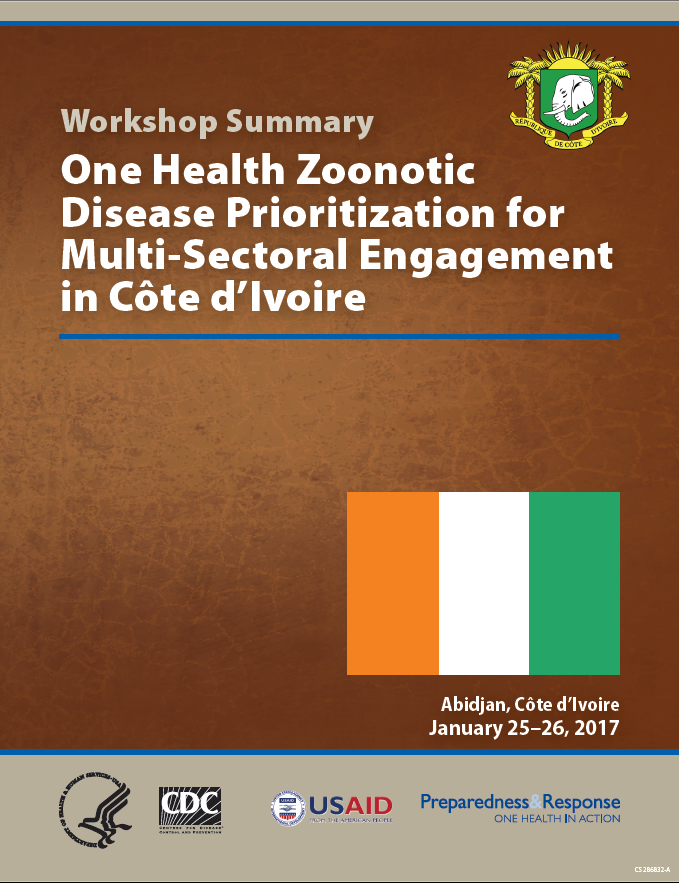 CDC’s One Health Office works with countries and partners around the globe to prioritize zoonotic diseases of greatest national concern. CDC experts lead One Health Zoonotic Disease Prioritization Workshops for countries that want to prioritize a list of their most urgent zoonotic disease threats. CDC’s One Health Office works with countries and partners around the globe to prioritize zoonotic diseases of greatest national concern. CDC experts lead One Health Zoonotic Disease Prioritization Workshops for countries that want to prioritize a list of their most urgent zoonotic disease threats.
These workshops bring together experts from many different areas who work to protect the health of people, animals, and the environment. Workshop participants collaborate to identify a country’s top zoonotic diseases to target for One Health collaborations and develop strategies to tackle the newly prioritized zoonotic diseases.
A new report from Côte d'Ivoire's workshop is now available. The report is also available in French. Other workshop reports are available on CDC’s One Health website.

|
|
|
|
|
|
|
Find updates about One Health, diseases spread between humans and animals, new infographics, and much more on our homepage.
|
|
| "Canaries in the coal mine" - Dr. Tracey McNamara comments - Tuesday, June 26, 2018 |
A One Health approach could help save your life...if the powers-that-be start thinking and acting ‘outside the box’!
SEE: https://www.youtube.com/watch?v=qm8NnL582uc

|
|
| WONCA (World Organization of Family Doctors [physicians]) http://www.globalfamilydoctor.com/ Reiterates Recognition/Support of One Health Principles in June 22, 2018 Newsletter to members - Friday, June 22, 2018 |
WONCA (World Organization of Family Doctors [physicians]) http://www.globalfamilydoctor.com/ Reiterates Recognition/Support of One Health Principles in June 22, 2018 Newsletter to members ...
“ ... WONCA and One Health Initiative
For a number of years WONCA has supported the aims and objectives of the One Health Initiative. The mission statement of the Initiative is:
Recognizing that human health (including mental health via the human-animal bond phenomenon), animal health, and ecosystem health are inextricably linked, One Health seeks to promote, improve, and defend the health and well-being of all species by enhancing cooperation and collaboration between physicians, veterinarians, other scientific health and environmental professionals and by promoting strengths in leadership and management to achieve these goals.
This has increasing relevance in today’s complex interaction between man, animals and the environment, as evidenced by the spread of antimicrobial resistance and the emergence and re-emergence of vector-borne and zoonotic infections. To find out more about One Health go to their website at: http://www.onehealthinitiative.com” ...”
Note: Dr. Garth Manning [MB BCh BAO, DRCOG, DAvMed, MRCGP, FRCGP], Chief Executive Officer (CEO) World Organization of Family Doctors [physicians] (WONCA), (Thailand)] is a member of the OHI team Advisory Board http://www.onehealthinitiative.com/advBoard.php.
|
|
| Heart Disease, an important “One Health” approach issue for comparative medicine research - Thursday, June 21, 2018 |
Heart Disease, an important “One Health” approach issue for comparative medicine research...worth repeating:
“The One Health Concept: How Multidisciplinary Training and Collaboration Leads to Major Advances in Health Care” endorsement by one of the principle discoverers of the First Balloon-Expandable Coronary Stent, Gary S. Roubin, DVM, MD, PhD, Medical Director, Cardiovascular Associates of the Southeast, 3980 Colonnade Parkway, Birmingham. AL 35243
https://goo.gl/cZ61UE
|
Renowned Physician Interventional Cardiologist Endorses One Health Concept – Posted One Health Initiative website Tuesday, September 05, 2017
|
|
Renowned Physician Interventional Cardiologist Endorses One Health Concept
The One Health Concept: How Multidisciplinary Training and Collaboration Leads to Major Advances in Health Care
A One Health endorsement message from Gary S. Roubin, BVSc. (Hons.), MB, BS., PhD, MD, FRACP, FACC, FAHA, FSCAI
Cardiovascular Associates of the Southeast Birmingham, Alabama
Please see http://www.onehealthinitiative.com/publications/The%20One%20Health%20concept%20is%20a%20worldwide%20strategy%20for%20expanding%20interdisciplinary%20collaborations%20and%20communications%20in%20all%20aspects%20of%20health%20care%20for%20humans.pdf or https://goo.gl/cZ61UE.
“The One Health, One Medicine philosophy of multidisciplinary collaboration has the extraordinary potential to expand scientific knowledge and innovation in health care. This collaboration can improve the longevity and quality of life for millions of patients. There is marked synergy between animal and human health. The way scientific collaboration between the Veterinary and the Medical community can improve patient care is well illustrated by the development of the First Balloon Expandable Coronary Stent. *
The writer was fortunate to have completed a 5-year Veterinary Medical Degree followed 1-year later by a 5-year Medical Degree at the University of Queensland, Australia. Following clinical training that culminated in specialist qualifications in Cardiovascular Diseases, he completed his education with a PhD in Cardiac Hemodynamics at Sydney University, Australia.
A National Heart Foundation Fellowship took him to Emory University in Atlanta Georgia USA to work with Professor Andreas Gruentzig – the pioneer of Coronary Balloon Angioplasty. Coronary angioplasty was plagued by the shortcoming abrupt vessel collapse and closure complicating this potentially valuable procedure.
The writer’s multidisciplinary skills facilitated successful research in multiple animal species and disease models. He collaborated closely with fellow veterinarians at Emory University and the University of Alabama at Birmingham.
This work culminated in the development of the first balloon expandable coronary stent and first FDA approved coronary stent in 1994. The innovative, early clinical work and the scientific foundation of the preclinical animal studies was the underpinning for a medical procedure that has been used in hundreds of millions of patients since its introduction.
Coronary stenting revolutionized coronary intervention - saving lives in patients with unstable coronary syndromes and improving quality of life in countless others.
Utilizing his multidisciplinary Veterinary and Medical skills the writer has gone on to develop devices for stenting of the carotid artery, embolic protection filters for the brain and devices for closing large bore access punctures in arteries.
There can be no doubt about the unique potential for the One Health Model for Multidisciplinary Training and Collaboration.”
*The First Balloon-Expandable Coronary Stent: An expedition that Changed Cardiovascular Medicine.: Roubin, Gary: University of Queensland Press 2014
[https://www.amazon.com/First-Balloon-Expandable-Coronary-Stent-Cardiovascular-ebook/dp/B00QEGEQXG]
Gary S. Roubin, MD, PhD
(917) 217 6070.
garyroubin@aol.com
Medical Director
Cardiovascular Associates of the Southeast
3980 Colonnade Parkway
Birmingham. AL 35243 groubin@cvapc.com
(205) 510 5000
Provided by Dr. Gary S. Roubin to the One Health Initiative team’s website September 4, 2017 via Bruce Kaplan, DVM https://goo.gl/XwQMfw, and Peter G. Anderson, DVM, PhD, University of Alabama (USA) School of Medicine http://apps.medicine.uab.edu/FacultyDirectory/FacultyData.asp?FID=19493.
Note: Dr. Roubin and his colleagues’ notable One Health achievement, i.e. development of the First Balloon-Expandable Coronary Stent, was first reported by the One Health Initiative team in the One Health Initiative website February 9, 2010 https://goo.gl/xjnr9Z.
|
|
|
|
|
|
|
|
|
|
| 5th International One Health Congress, 22-25 June 2018 - The final programme of the world's premier One Health congress is now available. Registration is still possible! - Monday, June 18, 2018 |
|
5th International One Health Congress, 22-25 June 2018
SEE: https://mailchi.mp/onehealthplatform/one-health-platform-media-bulletin-october-202601?e=49188b2102
The final programme of the world's premier One Health congress is now available. Registration is still possible!
|
|
World Bank One Health Operational Framework
The World Bank has released an Operational Framework for Strengthening Human, Animal and Environmental Public Health Systems at their interface (“One Health Operational Framework”). This new framework, developed in partnership with EcoHealth Alliance, aims to provide a basis for understanding and implementing a One Health approach in global and country investments. Building on World Bank’s prior “People, Pathogens, and our Planet” reports, it examines the strategic context, rationale and case for investing in One Health, provides an inventory of tools and other resources from the human health, agriculture, environment and disaster risk reduction sectors to facilitate multi-sectoral coordination, and incudes technical guidance for appropriate One Health entry points and operations along the prevent-detect-respond-recover spectrum of preparedness.
Free download |
|
<Paper> Core Competencies in One Health Education: What Are We Missing
Ensuring appropriate education and training across human, animal, and environmental health to respond to today’s public health threats is critical - but not easy. The growing trend in One Health educational programs is an important step, though it has been unclear if and how core competencies are applied.
The authors of the newest National Academy of Medicine (NAM) Perspectives paper assess the evolution of existing One Health core competencies and provide an analysis of One Health degree programs across the US including key areas represented, knowledge gaps, and recommended improvements for preparing future One Health leaders.
More information |
|
Your feedback is requested on The Sustainability of One Health Coordination
The USAID-funded Preparedness and Response (P&R) Project is conducting a pairwise survey to better understand the factors that make One Health coordination and collaboration sustainable. Preliminary results from the survey will be shared at the upcoming International One Health Congress in Saskatoon during the SPI track session “Making One Health operational: the barriers to change glimmers of hope.” Please take a few minutes to participate in the pairwise wiki survey here.
If you have any questions on the survey or would like to see the final report, please feel free to contact Robert Salerno at Robert_Salerno@dai.com. |
|
|
|
|
| Important One Health issue - RE S.2852, Pandemic and All-Hazards Preparedness and Advancing Innovation Act of 2018, a bipartisan bill - Wednesday, June 13, 2018 |
Urgent help needed…to all One Health supporters and advocates!
Please contact (write and call) your U.S. Senators and House of Representatives congresspersons:
Regarding S.2852, Pandemic and All-Hazards Preparedness and Advancing Innovation Act of 2018, a bipartisan bill https://www.help.senate.gov/hearings/s2852-pandemic-and-all-hazards-preparedness-and-advancing-innovation-act-of-2018. Note that One Health is a nonpartisan issue for the benefit of ALL… “One Health is the collaborative efforts of multiple disciplines working locally, nationally, and globally to attain optimal health for people, animals, plants and our environment. One Health implementation will help protect and/or save untold millions of lives in our generation and for those to come.”
“There was a key phrase left out of the adoption of Senator Tina Smith (Democrat, Minnesota) and Senator Todd Young (Republican, Indiana) One Health amendment to PAHPA. It is critical to insert “through a One Health Framework” where Senator Smith proposed.
Many federal Departments and Agencies are working together but more in parallel than in true collaboration. Some are already developing a “One Health Framework” and need Congress to direct the development and use of such a framework to move from rhetoric to reality.
Working together works. The One Health approach works to save money and lives. Three words is all it will take to make this a reality.”
|
|
| Promoting cross-campus collaborations in health research - University of Pennsylvania (USA) - Tuesday, June 12, 2018 |
| |
One Health – Google alert
Daily update ⋅ June 12, 2018
|
|
| |
NEWS
Promoting cross-campus collaborations in health research
Penn’s One Health Communications Group highlights faculty and students bridging academic fields in research and innovation
|
|
| |
“... “We created the group knowing that cross-disciplinary research was an area in which Penn excels,” says Katherine Unger Baillie, a science news officer in Penn’s Office of University Communications. “But, once we started meeting, we discovered that there are more examples than we were even aware of. Now not only are we trying to identify new projects and new research coming down the pike, but we’re also looking for ways we can promote and enhance these collaborations.”
While the group began with representatives from what may typically be considered Penn’s four health schools—the Perelman School of Medicine, School of Veterinary Medicine, School of Nursing, and School of Dental Medicine—it has since expanded to include representatives from the School of Engineering and Applied Science, School of Arts and Sciences, Annenberg School for Communication, and Kleinman Center for Energy Policy. This expansion broadens the traditional one-health perspective to be more inclusive of the interdisciplinary work at Penn.
The idea of “one health” encapsulates the notion that animal, environmental, and human health are all interconnected. For example, in 2010, more than 400 northern Nigerian children died from a mysterious disease. Health officials determined that high levels of lead exposure due to nearby gold mining caused the tragic deaths. ...”
Promoting cross-campus collaborations in health research
Penn: Office of University Communications
Three years later, the Penn One Health Communications Group has a vibrant web presence, several media events under its belt, and a wealth of ...
|
|
SEE: https://penntoday.upenn.edu/news/promoting-cross-campus-collaborations-health-research
|
|
| CSIRO moonshot on precision health [using One Health approach] - Friday, June 08, 2018 |

Aimee Chanthadavong
June 8, 2018
CSIRO moonshot on precision health
SEE: https://www.innovationaus.com/2018/06/CSIRO-moonshot-on-precision-health
Science
Google News alert: CSIRO moonshot on precision health
http://www.innovationaus.com/
“The 'one health' model means we now understand that the solutions won't come from one single discipline or institution. The challenges are complex, ...
Larry R. Marshall, PhD
Chief Executive of the Commonwealth Scientific and Industrial Research Organisation

Dr. Larry R. Marshall is an Australian entrepreneur and physicist. In January 2015, he became chief executive of the Commonwealth Scientific and Industrial Research Organisation, Australia's national science.
https://www.bloomberg.com/research/stocks/private/person.asp?personId=31020378&privcapId=7372916
“...Dr Marshall suggested that for the country to achieve this target, Australia needed a cross-disciplinary “one health” approach. This means that government, industry, and research institutions must partner up.
“The ‘one health’ model means we now understand that the solutions won’t come from one single discipline or institution. The challenges are complex, and need innovative new approaches. But we know innovation happens at the intersection of people and perspectives,” he said.
Dr. Marshall said the “one health” approach meant taking advantage of the agency’s genetic research that was previously used to solve problems around plants, animals and water.
“Our environment, water, plants, animals and humans – we used to consider all of these elements separately, but our future is the intersection of all of them,” he said. ...”
|
|
|
|
|
|
|


